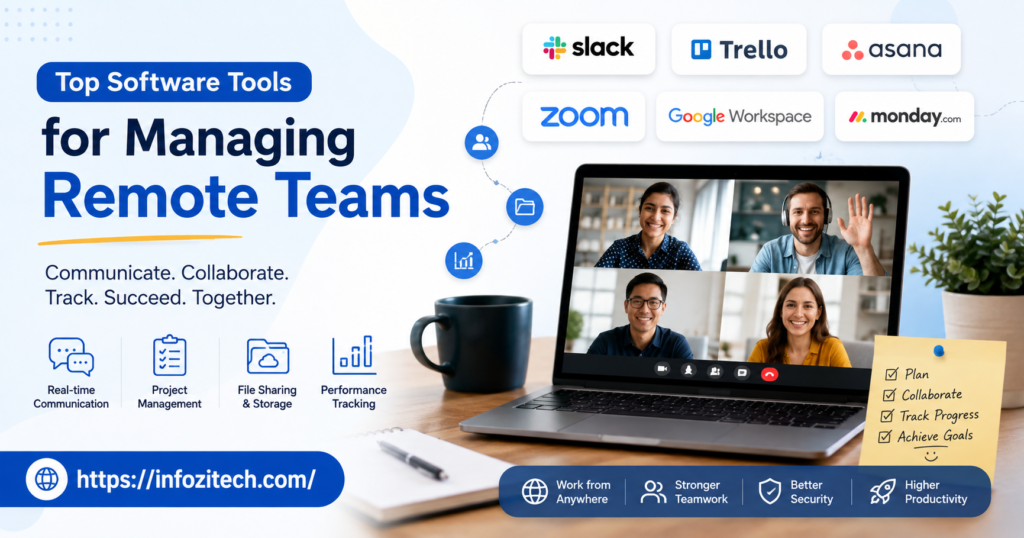
Software Tools for Managing Remote Teams: A Practical Guide
Managing a team in the same office has this built-in accountability nobody really thinks about until it’s gone. None of that happens automatically with a remote team, not one bit of it.
This is exactly why so many first-time remote managers feel like they’re constantly one step behind, always. Not because they’re worse at managing; that’s not it at all. It’s that the informal signals they used to lean on are simply gone, and nothing’s replaced them yet. A task quietly stalls and nobody notices till it’s overdue.
Software tools exist to close that gap. So here’s a walk-through. What these tools actually do. Why they matter even for a small distributed team. And how to put a setup together that doesn’t turn into fifteen apps nobody can keep straight in their head.
What Do Remote Team Management Tools Actually Do?
At the most basic level, these tools recreate the visibility and communication that happens naturally in an office, just artificially, on purpose. They give a distributed team a shared place to talk, a shared way to track work, a shared sense of what everyone else is actually doing even when nobody’s anywhere near each other physically.
Take a simple daily check-in as an example. In an office, that happens informally; somebody mentions what they’re working on while grabbing coffee, no effort involved. Remotely, that same update needs an actual channel, a quick written post, a short video huddle, something replacing the accidental conversation with an intentional one someone has to actually initiate.
Helps to separate the main categories here, since they solve pretty different problems.
- Communication tools handle day-to-day conversation, chat, video calls, and quick updates.
- Project and task tracking tools show what’s being worked on, by who, and what stage it’s at.
- Time and availability tools help coordinate schedules across time zones and track hours where that matters.
Most remote teams need at least one solid tool from each category. Trying to force a single platform to handle all three usually means it does none of them particularly well, spread too thin.
Why This Matters Even for a Small Remote Team
There’s an assumption floating around that remote management tools are mainly for huge, distributed companies with hundreds of people spread across continents. In reality, even a five-person remote team runs into the same core problems, just at a smaller scale, and honestly, the smaller the team, the less room there is to absorb a dropped ball without it actually mattering.
A few honest reasons this matters right from the start.
You avoid silent misalignment. Without visible tracking, two people can work on conflicting versions of the same task for days, sometimes longer, before anyone notices, simply because there was no shared place showing what was already in motion.
You protect against burnout you literally cannot see. In an office, you notice when someone looks exhausted; it’s right there in front of you. Remotely, that same person could be quietly drowning with zero visible sign, unless workload’s tracked somewhere everyone can actually check.
You cut down on time zone friction. The right scheduling and async tools mean work doesn’t grind to a halt just because half the team’s asleep while the other half’s online and waiting.
You build trust through visibility instead of surveillance. When people can see progress happening across the team, they worry less about whether things are actually getting done, which cuts way down on those anxious little check-in messages nobody enjoys sending or receiving, ever.
None of this requires an intimidating tech stack, not at all. A handful of well-chosen tools, used consistently, does more than a dozen tools that half the team never even opens.
Common Types of Software for Remote Team Management
Vendors love branding new categories constantly, but for most remote teams it comes down to a fairly manageable set of tool types.
Chat and Messaging Platforms
Handle quick, ongoing conversation, replacing physical office chatter with organized channels and direct messages. Essential for remote work, honestly, since without one, communication scatters across email, texts, whatever app happens to be open at the moment somebody has a question.
Video Conferencing Tools
Used for scheduled meetings, obviously, but increasingly for quick, informal check-ins too- the kind that would’ve happened at someone’s desk in an office. A decent video tool cuts back on the isolation that creeps in when every single interaction happens through text.
Task and Project Management Software
Gives the team a shared, visible record of what’s being worked on and by whom, exactly. Often the single most important tool here, since it replaces the visual cues of an office with something everyone can check on their own, whenever.
Time Zone and Scheduling Tools
Help coordinate meeting times and working hours across a distributed team, without the endless back-and-forth trying to figure out when everyone’s actually free at the same moment.
Document and Knowledge-Sharing Platforms
Store information somewhere everyone can reach, instead of trapped in one person’s inbox or a local folder on their laptop. Especially important remotely, since there’s no way to just ask the person next to you where a file’s saved.
You don’t need every category filled with its own dedicated tool. Figure out which gaps in your current setup are actually causing real problems.
How to Choose the Right Tools for Your Remote Team
This is usually where people get overwhelmed, since there are dozens of options in every single category, each one insisting it solves remote work entirely on its own. A more grounded approach helps narrow it down.
Start With Your Team’s Actual Pain Point
Missed updates the main issue? Start with task tracking. Isolation and disconnection the bigger worry? Prioritize communication and video tools instead. Solving the most pressing problem first matters way more than assembling some complete toolkit right away.
Prioritize Tools That Work Across Time Zones
If your team spans multiple time zones, look specifically for tools built with asynchronous use in mind, ones that don’t just assume everyone’s online at the same time. A tool that only really works for real-time collaboration creates friction the second your team isn’t all awake together, which, if you’re distributed, is most of the time.
Avoid Overlapping Tools
Common problem: remote teams end up with two chat apps, three ways to share files, no clear rule about which to use when. Before bolting on a new tool, check whether something you already have covers that need reasonably well already.
Check Mobile Access
Remote doesn’t always mean deskbound, obviously. If people work from different spots throughout the day, tools that actually function well on mobile matter more than they might for an office team glued to one desktop all day.
Trial Tools With a Real Project, Not a Demo Team
Whenever you can, run an actual current project through a new tool instead of testing with some fake sample team that doesn’t reflect anything real. That’s the only genuine way to know whether it fits how your team communicates and works day to day.
Setting Up Your Remote Team’s Toolkit Without Overloading Everyone
Once you’ve picked your tools, resist rolling out every feature at once, all at the same time. A sudden pile of new software, new channels, new processes tends to overwhelm a team rather than actually help it, and people just disengage.
A steadier rollout looks something like this.
Start with the single biggest gap. Communication, task visibility, scheduling- whatever it is- fix the most pressing issue first instead of trying to overhaul everything simultaneously in one big push.
Set clear expectations for what each tool’s actually for. Chat’s for quick questions; the project tool’s for task updates- say so explicitly, or people default to whatever feels easiest in the moment, which usually just means everything ends up dumped in chat.
Establish a simple daily or weekly rhythm. A short daily check-in post, or a weekly summary, keeps everyone aligned without demanding constant real-time availability from a team that’s spread out across time zones.
Give the team time to adjust before piling on more. Introduce one or two tools well before layering on additional ones, so people actually build real habits around what’s already there instead of drowning.
Revisit the toolkit now and then. What worked for a three-person remote team might need adjusting once you’re at ten, so check in periodically on what’s genuinely being used versus what’s quietly being ignored by everyone.
Mistakes Teams Commonly Make With Remote Tools
A few patterns keep showing up when teams first build out their remote management setup.
Adopting too many tools all at once. Usually creates more confusion than it solves, since nobody’s sure which platform to check for which kind of update anymore.
Choosing tools built for massive enterprises. These often come loaded with unnecessary complexity and a steep learning curve; a small remote team just doesn’t have the bandwidth to work through right now.
Relying entirely on real-time communication. Without async options, a distributed team ends up constrained by whoever happens to be online at that exact moment, which defeats a lot of the flexibility remote work’s supposed to actually offer people.
Skipping documentation entirely. If institutional knowledge only lives in people’s heads or scattered old messages, onboarding new team members turns unnecessarily hard.
Never checking whether tools are actually getting used. A tool nobody opens isn’t helping anyone, no matter how carefully it was chosen at first. Periodic check-ins reveal what’s genuinely working versus what’s just sitting there.
Bringing It All Together
Software tools for managing remote teams were never about recreating an office experience through a screen; that’s not really possible anyway. They’re about giving a distributed team the visibility, communication, and coordination that would otherwise happen by accident in a shared physical space, back when that was the default.
Start with your team’s most pressing gap, choose tools that fit how your team actually works across time zones and habits, and introduce them gradually enough that people actually adopt them instead of tuning them out. The goal was never the most impressive tech stack out there. It’s the smallest set of tools that keeps a remote team genuinely connected and aligned.
Once that setup’s in place, silent misalignment gets rare, isolation eases up, and a remote team starts operating with the kind of steady rhythm that used to depend entirely on everyone just being in the same room together.