
AI Travel Planner for Business Trips: How Smart Tools Are Changing Corporate Travel
I missed a connecting flight in Denver two years ago because nobody flagged that my layover was seventeen minutes shorter than what the airline actually needed to get bags across the terminal. Stood at the gate watching the door close. That’s the kind of thing that gets you thinking about whether there’s a smarter way to plan a trip than clicking through five booking tabs at midnight and hoping for the best.
There is, apparently. AI travel planners have gone from a gimmicky add-on nobody trusted to something a lot of companies now lean on daily. Not because it’s trendy — because the old way of doing this was genuinely broken in a dozen small ways that added up.
So what are these tools actually doing, why do they matter more for business trips than vacation ones, and how do you pick a decent one without getting sold a bunch of buzzwords? Let’s get into it.
What Is an AI Travel Planner, Exactly?
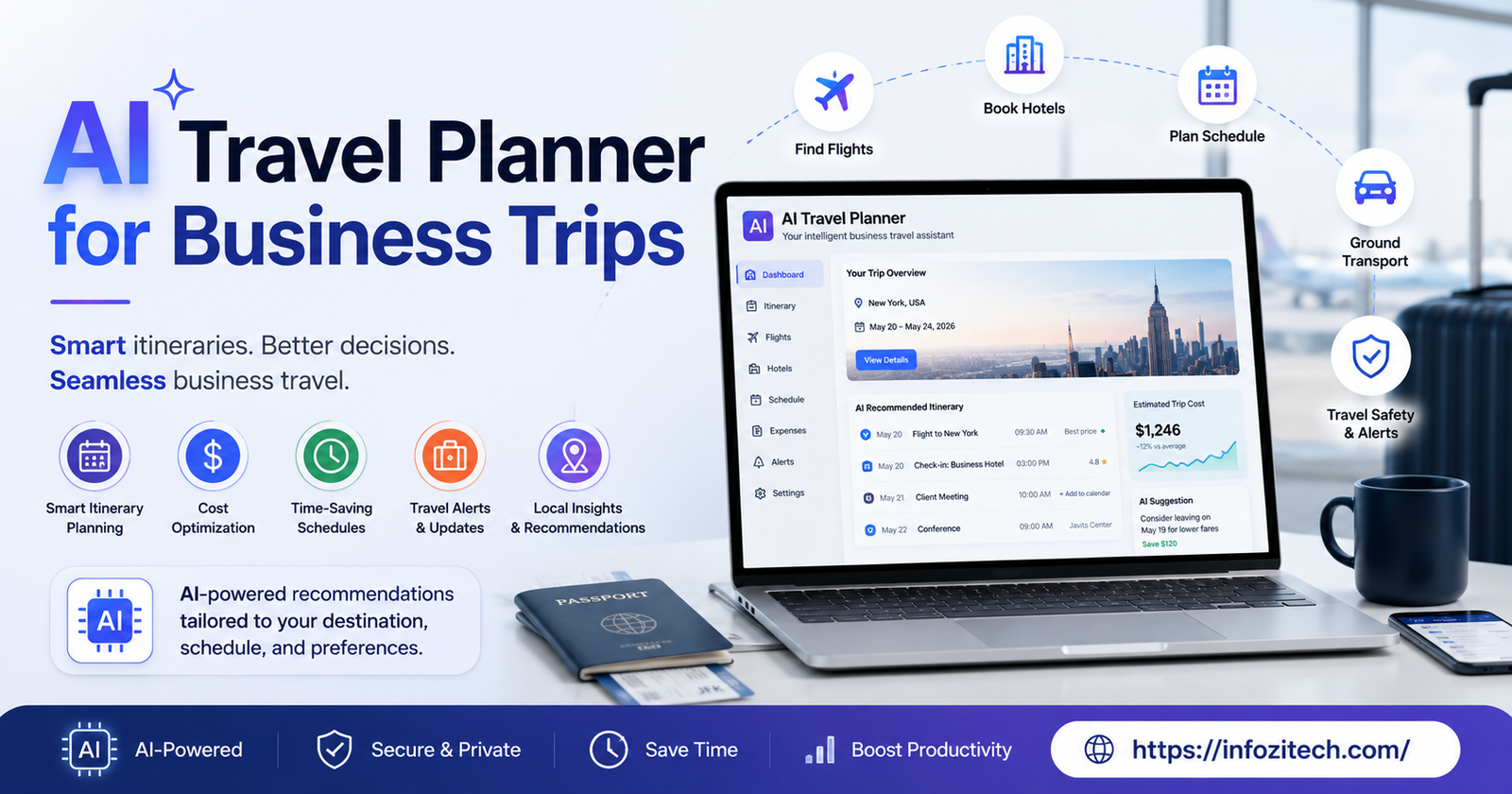
Strip away the marketing, and it’s software that uses machine learning (and some natural language processing) to do the research-and-booking grind a travel agent or an overworked admin used to handle. You tell it where you’re going, when, what constraints matter — budget, hotel proximity, whatever — and it assembles the trip. Flights. Hotels. Ground transport. Sometimes even a dinner reservation if you ask nicely.
The part that actually matters isn’t the booking itself, though. Any website can book a flight. It’s the reasoning layer underneath. A search engine hands you a list of options and walks away. An AI planner reads what you actually need, checks it against your company’s travel policy, looks at your calendar, and pulls from patterns across thousands of other trips to make a call that’s more informed than “cheapest flight wins.”
How It Differs from Traditional Travel Booking Tools
Old corporate booking portals were basically digital filing cabinets with a search bar bolted on. You typed, you filtered, you clicked book, done — that was the entirety of the “smarts” involved. Flight got cancelled? You’re on your own untangling it. Went over budget? Nobody notices until finance flags it three weeks later, and now you’re explaining yourself in an email thread.
AI-driven tools flip that. They’re proactive instead of reactive, which sounds like a buzzword but really just means they watch instead of wait. If your usual 7 a.m. Chicago flight has been running late four times this month, a decent planner tells you that before you book it. Not after you’ve already missed the client meeting because of it.
Why Business Travelers Are Switching to AI-Powered Planning
Nobody’s adopting this stuff because it’s shiny. They’re adopting it because business travel wastes real time and real money in ways that are easy to ignore until you actually add them up.
Time Savings That Actually Add Up
Try planning a two-city trip by hand sometime — checking flights, comparing hotels against where the client’s office actually is, sorting out ground transport, fitting it all around meetings that keep shifting. An hour, easily. Sometimes more. Do that every week and you’ve burned entire workdays a year just on logistics, not the job you’re actually there to do.
An AI planner shrinks that to minutes. You type something like “need to be in Austin Tuesday morning, Dallas Wednesday afternoon, keep it under budget, somewhere near downtown” and it spits back a workable itinerary almost instantly. Multiply that across a hundred employees who travel constantly, and you’re talking about thousands of hours a year that go back to actual work instead of tab-hopping between booking sites.
Cost Control Without the Spreadsheet Headache
Budgets leak slowly. A nicer hotel here because it was easier to book. A last-minute upgrade there. A rental car nobody checked against whether a rideshare would’ve been cheaper for a two-day trip. None of it looks bad on its own. All of it adds up by Q4.
AI planners catch this because they’re comparing every option against policy limits in real time — not after the fact, when someone in finance is squinting at an expense report wondering why the Denver trip cost twice what the Chicago one did. Some tools go further, applying negotiated corporate rates automatically or factoring in loyalty program value. Over a year, the savings from smarter booking alone can pay for the software a few times over. That’s not a marketing line; that’s just what happens when nobody’s booking the convenient option out of habit anymore.
Real-Time Adjustments When Plans Fall Apart
If you’ve traveled for work more than a handful of times, you already know plans rarely survive contact with reality. Flights get delayed. Meetings get moved up a day with zero warning. Weather shuts an airport down, and suddenly your whole itinerary is garbage.
This is honestly where AI tools earn their keep the most, in my opinion — not the initial booking, the recovery. Because they’re monitoring the trip continuously, a lot of them catch the problem before you do. Rebooking or suggesting a reroute before your phone even buzzes with the delay notification. Business travel isn’t like a vacation where a missed connection just means an annoying afternoon in an airport. A missed connection here can mean missing the entire reason you flew out.
Core Features to Look For in a Business Travel AI Tool
Not everything marketed as an “AI travel planner” is actually built for corporate use. Some of it is a consumer trip-planning app with a business logo slapped over the top, and it shows the moment you try to apply a policy rule. Here’s what actually separates the two.
Smart Itinerary Building
Good tools build a coherent trip, not a pile of separately-booked pieces. They account for travel time between locations, jet lag, buffer around meetings. If a tool books your flight landing twenty minutes before your first meeting, that’s not intelligence, that’s a scheduling bug wearing an AI label.
Policy Compliance and Expense Integration
Once you’re past a handful of employees, policy compliance stops being optional. A useful planner applies spending limits automatically, flags anything out-of-policy before it’s confirmed (not after — before is the whole point), and syncs directly with your expense system so nobody’s manually re-entering receipts they already booked through the tool in the first place.
Predictive Alerts for Delays and Disruptions
This is the part that actually feels like AI doing something a spreadsheet couldn’t. Tools pulling from historical flight data, weather trends, and airport congestion patterns can warn you a delay is likely before it happens — not after a gate agent grabs the intercom. That lead time is the difference between calmly rebooking from your hotel lobby and sprinting through a terminal with a rolling bag banging your ankle the whole way.
How AI Travel Planners Handle the Messy Parts of Business Trips
Business trips are rarely a clean point A to point B. They’re multi-leg, tightly packed, and built around meetings that move around like they’re allergic to staying put. This is where a decent tool and a genuinely good one stop looking the same.
Multi-City Trip Coordination
Say you’re hitting three offices in four days, two countries. Doing that manually means juggling multiple booking sites, time zones, and whatever documentation each country wants from you. AI planners treat the whole thing as one connected trip instead of separate bookings stitched together after the fact, which means they catch conflicts — a connecting flight landing after your next meeting already started, say — that are easy to miss when you’re booking leg by leg.
Meeting-Aware Scheduling
The better tools plug directly into your calendar. So the itinerary isn’t just built around what flights exist, it’s built around when you actually need to be sitting across a table from someone. Client bumps a meeting from Tuesday to Wednesday? A calendar-aware planner flags that your current flights don’t make sense anymore and offers alternatives, instead of you finding out the hard way when you’re already checked into the wrong hotel.
Choosing the Right AI Travel Planner for Your Company
There are dozens of these tools now, all claiming roughly the same thing. Picking the right one comes down less to features on a comparison chart and more to how your company actually travels. A five-person startup taking the occasional trip needs something very different from a two-hundred-person sales team that’s basically living out of hotel rooms.
Questions to Ask Before You Commit
Before signing anything, get real answers. Does it integrate with the calendar and expense systems you already use, or is it another separate workflow employees now have to babysit on top of everything else? What happens at 11 p.m. when a flight gets cancelled — is there actual human support, or a chatbot that loops you back to the same three options? And how’s it priced — per user, per trip, a cut of total travel spend — and does that pricing hold up as your travel volume changes?
Worth asking, too, how much control your travel managers keep. Some companies want it fully automated. Others want AI handling the routine stuff while a person reviews anything unusual — international trips, VIP clients, last-minute changes. Where you land on that depends on how much risk you’re comfortable handing to software.
Common Concerns (and Honest Answers)
New tech always raises questions, and glossing over them doesn’t make anyone trust the rollout more.
Will It Replace Human Travel Managers?
Not really, not yet at least. These tools are great at rules-based decisions — comparing flights, applying spending limits, rebooking after something falls through. What they’re not great at is judgment. Negotiating with a hotel over a service problem. Untangling a genuinely messy visa situation. Remembering that a specific client always wants the corner suite. Companies that adopt this stuff tend to shift their travel managers toward that higher-judgment work instead of cutting the role entirely — which, frankly, is a better outcome for everyone involved.
Is My Data Safe?
Fair question, given how much sits in a travel profile — passport numbers, payment info, exactly where an employee will be and when. Reputable platforms encrypt data both stored and in transit, and should be upfront about how long they keep it. Before adopting anything, it’s worth actually reading how the tool handles data protection compliance for your industry and region, and whether you get any say in how long your employees’ travel history sticks around.
Getting Started: A Practical Rollout Plan
Don’t flip the switch company-wide on day one. Start with a small pilot group — the people who travel constantly and will actually tell you when something’s broken instead of just quietly working around it. And make sure your travel policy is actually written down clearly enough for software to apply it. A vague policy produces inconsistent results no matter how good the AI underneath is; garbage in, garbage out still applies here.
Give that pilot group a few weeks and a real mix of trips — a simple one-city visit, something multi-leg, and ideally at least one trip that gets disrupted, because that’s genuinely where you find out if the tool’s worth keeping. Ask specifically about accuracy, how clunky or smooth it felt day to day, and whether the calendar and expense integrations actually worked the way they were supposed to.
The companies that get real value out of this treat it as something to keep tuning, not a box to check once. Policies shift, travel patterns change, and the tool needs the occasional look-under-the-hood to make sure it’s still matching how people are actually traveling six months later.
Final Thoughts
AI travel planners won’t fix everything about business travel — nothing fixes airport security lines — but they take a real chunk out of the friction. The repetitive booking work, the policy guesswork, the scramble when a flight gets cancelled at 6 a.m. For companies with people regularly on the road, the time and cost savings tend to justify the switch pretty quickly. Just don’t grab the flashiest tool on the market without checking whether it actually fits how your team travels. That Denver layover taught me that “looks good on paper” and “works in practice” are two very different things.





2 thoughts on “AI Travel Planner for Business Trips: How Smart Tools Are Changing Corporate Travel”