
Remote Worker Wellness Checklist: What Actually Helps
Month eight of working from home, a guy I used to work with — decent job, good pay, seemingly fine on paper — mentioned offhand that he hadn’t left his apartment in four days. Not stuck, not sick. Just hadn’t needed to. Groceries delivered, meetings on a laptop, gym membership he’d quietly stopped using back in March. Said it like it was a funny little fact about himself. It wasn’t funny. That was the moment I started actually paying attention to what remote work does to people when nobody’s checking in.
Not a checklist about ergonomic chairs, though chairs matter, sure. This is about the stuff that erodes quietly when the commute disappears, and the kitchen becomes the break room, and nobody in a building notices you look tired, because there is no building anymore.
Why Remote Work Wellness Gets Ignored Until It’s a Problem
Offices, whatever their flaws, came with built-in checkpoints. Somebody noticed when you looked off. A coworker dragged you to lunch whether you wanted to go or not. Walking to a meeting room counted as movement, technically. None of that survives the move home on its own. Most people don’t replace it with anything. They just absorb the loss and call it adjusting.
The Illusion of Flexibility
Remote work sold itself on flexibility, and that part’s genuinely real. What doesn’t get talked about enough — flexibility without structure tends to collapse into “work whenever,” which somehow just means work always. No natural stopping point. No walk to the parking lot signaling the day’s done. Just a laptop, closed maybe, reopened twenty minutes later because a notification popped up and you figured, quick look, no harm.
Isolation Doesn’t Announce Itself
Nobody wakes up and decides today’s the day they become isolated. Happens slowly. One skipped plan because a deadline came up. One video call turned off-camera because it was easier that way. A week where the only real conversations were with a manager about deliverables, nothing else. Add that up over months, and a person ends up genuinely lonely without ever clocking the exact moment it started.
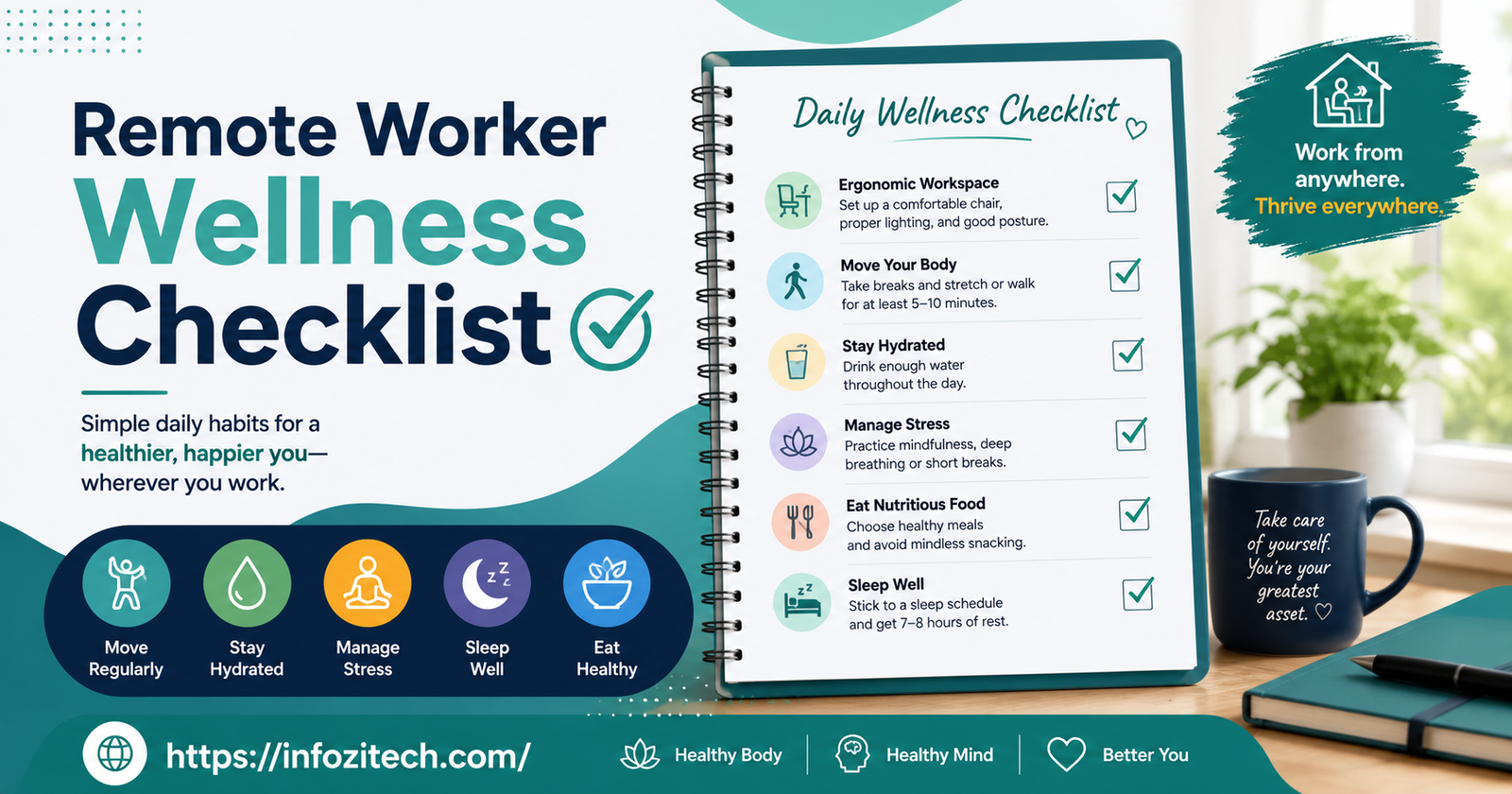
Physical Wellness Checklist for Remote Workers
Start here. Most concrete, honestly the easiest to fix once you actually notice it’s a problem in the first place.
Set Up a Workspace That Isn’t Your Bed
Working from bed feels harmless the first week. It isn’t. Wrecks sleep, because your brain stops associating the bed with sleeping — and wrecks posture in ways that show up as neck pain about six months later, right when you’ve completely forgotten to connect the two things. A desk. Even a cheap one. Somewhere that isn’t where you sleep. That’s the baseline. Not a luxury, not optional.
Actually Get Up Every Hour
Not some clever productivity trick. Just genuinely matters. Sitting eight-plus hours straight, bad for circulation, bad for the back, and — this part surprises people — bad for focus too. People assume sitting still equals more output. Often the opposite. Set a dumb timer if that’s what it takes. Stand, walk to the kitchen, walk back. Sixty seconds count.
Get Outside, Even Briefly
Doesn’t need to be a hike or anything close to it. Ten minutes around the block replaces something a commute used to hand you almost by accident — daylight, a change of scenery, a small bit of movement marking the shift from home-mode to work-mode. People who skip this entirely, their days start blurring together in a way that’s genuinely disorienting once you hear them describe it out loud.
Watch What “Lunch” Actually Looks Like
Standing at the counter eating while reading emails isn’t lunch. It’s just calories consumed near a laptop, which is a different thing entirely. Doesn’t need to be elaborate. Just needs to be a real break, away from the screen, sitting somewhere that isn’t the desk, longer than four minutes.
Protect Your Sleep Schedule Specifically
Remote work wrecks sleep more than people expect, mostly because the line between day and evening gets blurry with no commute marking the transition anymore. Same wake time, most days. Some kind of wind-down that isn’t just closing one screen and immediately opening a different one.
Mental and Emotional Wellness Checklist
Part people tend to skip on lists like this — harder to put a checkbox next to feelings. Doesn’t make it less important. Arguably the opposite.
Build In Actual Human Contact
Work video calls don’t count, not really — too transactional. What actually matters is unstructured contact. A call with a friend that isn’t about a deliverable. A coworking day at a coffee shop. A standing coffee chat with a coworker about literally nothing related to the project. Schedule it if that’s what it takes. Won’t happen on its own, ever.
Notice When Work Stops Having Edges
Checking Slack at 9 pm out of habit rather than actual necessity — worth noticing that, not just accepting it as the new baseline. Remote work makes it dangerously easy for the workday to have no real end. Just a slow fade into checking things “real quick” all evening long. Pick an end time. Actually stop at it.
Talk to Someone When Something Feels Off
Not everything needs professional support. But plenty of remote workers push through a rough patch entirely alone, specifically because there’s no coworker around noticing they seem different lately. Has something felt heavy for more than a couple weeks? Worth mentioning to a doctor, a therapist, someone. Not because remote work necessarily caused it. Because remote work makes it much easier to hide.
Watch for the Specific Remote Burnout Pattern
Regular burnout and the remote version don’t look identical, actually. Remote burnout often shows up as a weird numbness toward tasks that used to feel fine, paired with this nagging feeling of never being fully off, even during actual time off. Sound familiar? Worth taking seriously instead of assuming a slow week will fix it on its own.
Social Wellness Checklist for Remote Teams and Individuals
Wellness isn’t purely personal when you’re part of a team. Some of this genuinely depends on how the company operates, not just individual habits or willpower.
Push Back Gently on All-Video, All-The-Time Culture
Some meetings genuinely need video. Plenty don’t, and defaulting to camera-on for every single call adds a low hum of fatigue that piles up across a week without anyone naming it out loud. Worth advocating, even quietly, for audio-only where it actually makes sense.
Find or Build a Remote-Friendly Community
Coworking spaces exist for exactly this reason, and the membership fee’s worth it for a lot of people, even just one or two days a week. Online communities in your specific field can fill a similar gap when in-person isn’t realistic wherever you happen to live.
Set Boundaries With Family or Roommates Sharing Your Space
Not living alone? “I work from home” gets misread constantly as “I’m available,” and that misunderstanding causes way more friction than people expect going in. A closed door. A specific signal. Headphones on meaning do-not-disturb, nothing fancier than that. Small thing. Outsized impact on actually getting through a workday intact.
Building a Sustainable Remote Wellness Routine
None of the above sticks if it’s treated as a one-time fix instead of something revisited on purpose, regularly.
Review Your Setup Every Few Months
What worked month one of remote work often quietly stops working by month six, and nobody notices the shift while it’s happening. Revisit the physical setup, the schedule, the social habits every so often. Not because something’s necessarily broken — because circumstances change and routines need to catch up eventually.
Use a Real Checklist, Not Just a Mental One
Writing it down — desk setup, movement breaks, actual lunch, one non-work conversation a day, a hard stop time — makes it something you can track, instead of a vague intention that quietly slips by week three like it never existed. Doesn’t need to be fancy. A sticky note works fine.
Give Yourself Permission to Adjust the Rules
A checklist that feels like one more obligation piled onto an already full day gets abandoned fast, every time. The point was never perfect adherence. It’s noticing when something’s slipping and course-correcting before it turns into a pattern that’s harder to break later.
Signs You’ve Been Ignoring the Checklist for Too Long
Worth naming a few of these plainly. They tend to sneak up rather than announce themselves loudly.
You Can’t Remember Your Last Full Weekend Off
Not a vacation. Just a regular weekend where work didn’t creep in at all, not even a “quick check.” Struggling to place the last time that happened? Not a small thing. Usually the clearest sign the boundary between work and everything else has quietly dissolved somewhere along the way.
Your Only Conversations This Week Were About Work
Go back over the last five days. Every conversation, even the friendly ones, somehow circling back to a deliverable or a deadline? Worth sitting with that. Doesn’t mean anything’s catastrophically wrong. Does mean the non-work parts of life have gotten squeezed out further than probably intended.
You’ve Stopped Noticing How You Feel Physically
A lot of remote workers get so used to low-grade discomfort — stiff neck, tired eyes, that specific tiredness that isn’t really about sleep — it stops registering as something worth fixing at all. Can’t remember the last time your body felt good during a workday? That’s not just an ergonomics problem anymore, honestly.
Final Thoughts on Staying Well While Working Remotely
Nobody’s walking past your desk noticing you’ve eaten lunch at your keyboard three weeks running. Nobody’s catching you in a hallway asking if you’re doing okay after a rough stretch. That built-in safety net offices used to have, flawed as it always was, just doesn’t exist at home. Not unless someone deliberately rebuilds a version of it.
That guy who hadn’t left his apartment in four days — he’s fine now, for what it’s worth. Started scheduling actual walks. Joined a coworking space two days a week. Made a rule about not opening Slack after 7pm, no exceptions. Nothing dramatic about any of it. Just small, deliberate choices replacing what an office used to hand him for free, without him ever really noticing it was there until it wasn’t. That’s the whole point of a checklist like this one, really. Not perfection. Just enough structure that the things an office used to catch automatically don’t fall through the cracks once you’re doing this from home.







2 thoughts on “Remote Worker Wellness Checklist: What Actually Helps”