
Morning Mobility Routine for Desk Workers Over 30 (10-Minute Fix)
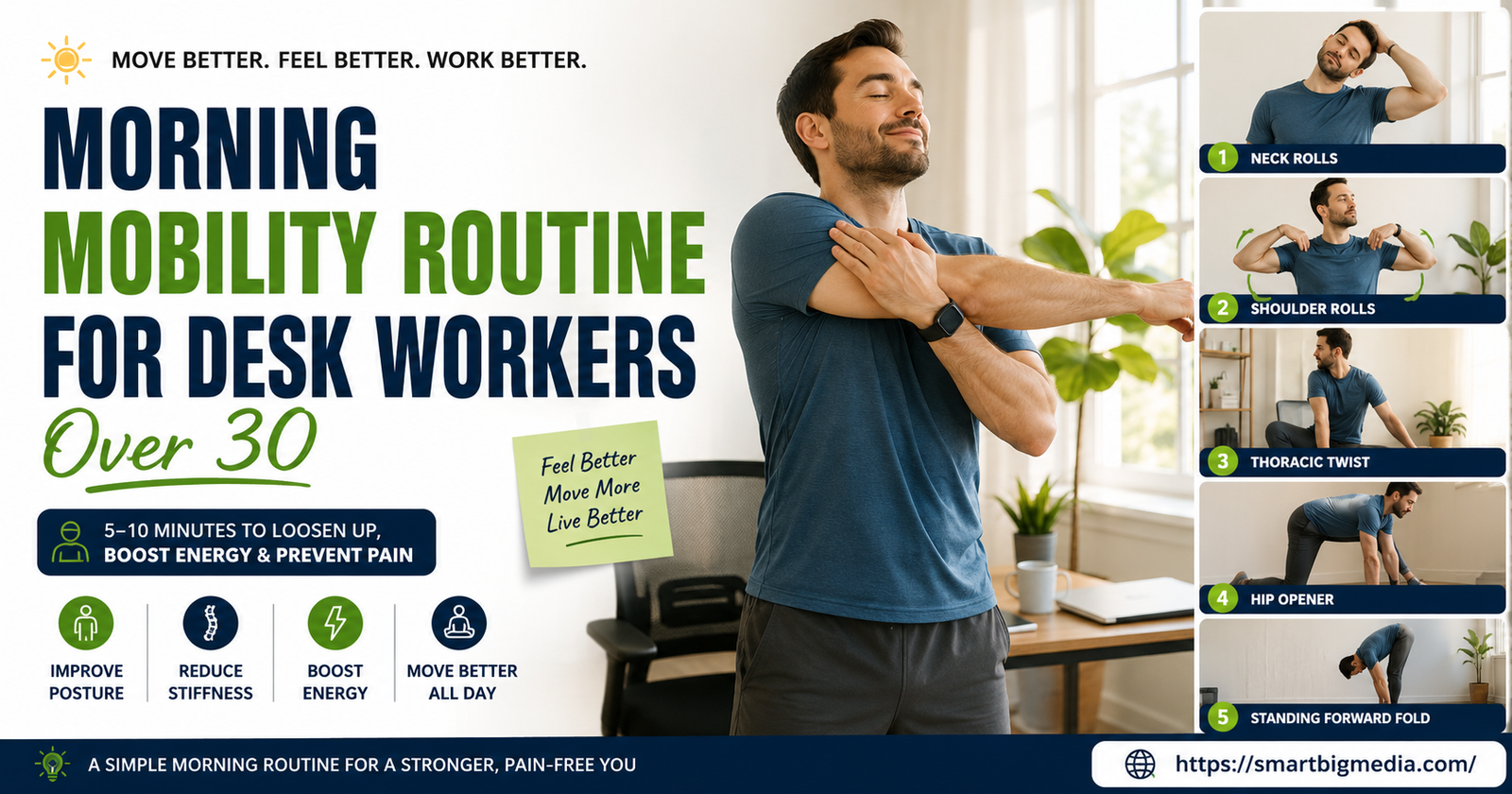
I used to be the person who rolled out of bed, grabbed coffee, and sat down at my laptop within four minutes flat. No stretching, no warm-up, nothing. And honestly, for most of my twenties that worked fine. Then I turned 31, spent a weekend moving boxes, and woke up Monday morning unable to turn my head to check my blind spot while backing out of the driveway. That was the wake-up call. Not dramatic, not an injury, just… my body quietly filing a complaint.
If you sit at a desk for a living and you’re past 30, you’ve probably had a version of this moment. Nothing broke. Nothing’s “wrong.” You just don’t move the way you used to, and your body seems to be renegotiating the terms every single morning.
This article isn’t about becoming a gym person or adding another hour to your routine. It’s about ten minutes — sometimes less — that undoes a lot of the damage sitting does before your day even gets started.
Why Your Body Starts Complaining After 30
Nobody sends you a memo about this, but somewhere around your thirties, recovery stops being automatic. In your twenties you could sleep in a weird position, skip stretching for a month, sit hunched over a laptop all weekend, and bounce back without thinking about it. That elasticity — literal and figurative — starts to fade.
Collagen production slows down gradually starting in your mid-to-late twenties, and joint fluid doesn’t replenish quite as fast either. None of this means anything is going wrong with you specifically. It’s just biology doing what biology does. The catch is that most of us don’t adjust our habits to match, so the gap between “what my body needs” and “what I’m actually giving it” quietly widens every year.
The Desk Job Multiplier
Add eight-plus hours of sitting into that mix and things speed up considerably. Your body is remarkably good at adapting to whatever position you spend the most time in, and for most office workers, that position is: hips bent, shoulders rounded forward, chin pushed slightly toward the screen. Do that five days a week for years and your body starts treating “hunched” as the default setting rather than a temporary posture.
The pattern that shows up is almost identical across desk workers — tight hip flexors, a stiff mid-back that barely rotates, weak glutes that have basically gone to sleep, and shoulders that live somewhere up near your ears by 2 p.m. A short morning routine, done consistently, works directly against this exact pattern. That’s the whole logic behind it.
Mobility Isn’t the Same Thing as Stretching
Quick tangent, because this trips people up constantly. Static stretching — holding a hamstring stretch for thirty seconds, that kind of thing — is about lengthening a muscle. It’s fine, it has its place, but it’s not really what desk workers need most.
Mobility is different. It’s training a joint to move actively through its full range, under some control, rather than just passively hanging out in a stretched position. Think of stretching as telling a muscle “relax,” while mobility is telling a joint “wake up, and remember how to do your actual job.” For someone who’s about to sit back down in an hour anyway, mobility work tends to carry over into real life far better — walking, bending, twisting to grab something off the back seat — because it’s teaching your body the movement pattern itself, not just a temporary state of looseness.
What Actually Belongs in a Morning Mobility Routine
Before jumping into the routine itself, it helps to know what you’re actually targeting. A good one hits a handful of specific areas, not randomly, but because these are exactly where desk work does the most damage.
Thoracic Spine Rotation
Your mid-back is supposed to rotate. When it doesn’t — and after years of sitting, it usually doesn’t — your lower back and shoulders end up compensating for movement they weren’t built to handle. A lot of “mystery” lower back tightness actually starts here, in a part of the spine most people never think about.
Hip Flexor Length
Sitting keeps your hips in a shortened position for the majority of your waking hours. Over years, that shortened length starts to feel “normal” to your body, which pulls on your lower back and even changes your walking pattern without you noticing. Morning hip work resets this daily instead of letting it stack up year after year.
Shoulders and Neck
Rounded shoulders and a forward-jutting neck are basically the uniform of desk work at this point. A few minutes spent opening the chest and getting the shoulder blades moving can head off the tension headaches and that specific 3 p.m. upper-back ache a lot of us just accept as normal.
Ankles (Yes, Really)
This one gets skipped constantly, but stiff ankles change how you walk, squat, and stand, and that shows up further up the chain in your knees and hips. It takes about a minute to address and almost nobody bothers.
The Routine: 10 Minutes, No Equipment
Do this slowly. Mobility work isn’t cardio — rushing through it defeats the point.
Step One: Cat-Cow Flow (1 Minute)
Hands and knees on the floor. Inhale, drop your belly, lift your chest and tailbone (cow). Exhale, round your spine toward the ceiling, tuck your chin (cat). Eight to ten slow breaths. This alone undoes a surprising amount of overnight stiffness, and it’s the one move I genuinely never skip, even on the worst mornings.
Step Two: Thread the Needle (1 Minute Per Side)
Still on hands and knees, slide one arm underneath your body and thread it through the gap between your opposite arm and leg, letting your shoulder and head rest on the floor. Directly opens the thoracic spine. Feels especially good if you sleep on your side, which — statistically — most people do.
Step Three: World’s Greatest Stretch (1 Minute Per Side)
Step one foot forward into a deep lunge, drop the back knee, place both hands inside the front foot, then rotate your torso and reach one arm toward the ceiling. It’s called the “world’s greatest” for a reason — hips, hamstrings, and thoracic spine, all in one movement. Slightly awkward the first few times. Worth it.
Step Four: Hip Circles (1 Minute)
Stand, hands on hips, make slow, large circles in one direction, then switch. Simple, a little silly-looking, and genuinely effective at lubricating a joint that’s been locked in one position for eight hours a day.
Step Five: Shoulder Rolls and Wall Slides (1 Minute)
Back against a wall, arms bent at ninety degrees like a goalpost. Slide your arms up and down slowly while keeping contact with the wall the whole time. Targets exactly the muscles that go weak and lazy from rounded, hunched sitting.
Step Six: Ankle Rocks (1 Minute)
Rock your weight forward onto your toes, then back onto your heels. Circle each ankle a few times. Feels almost pointless in the moment. Isn’t.
Step Seven: Deep Squat Hold (1–2 Minutes)
Lower into the deepest squat you can manage comfortably, heels down if possible, and just hold there, rocking gently side to side. Ankles, knees, and hips, all mobilized together. Honestly might be the single most useful position missing from the average desk worker’s entire day.
Stick with this daily and most people notice a real difference within two or three weeks — getting up from a chair without the little groan, walking down stairs more easily, standing up straight without consciously correcting yourself.
Actually Making It Stick
Knowing the moves is the easy 20%. The other 80% is just… doing it enough times that it stops feeling optional.
Attach it to something you already do. Don’t rely on willpower, because willpower is unreliable at 6:15 a.m. Stack it onto brushing your teeth, or the two minutes while your coffee brews. Removing the decision-making step is what actually makes habits survive past week one.
Lower the bar on bad days. Some mornings you’ll have ten minutes. Some mornings you’ll have ninety seconds before you have to leave. On those days, just do the deep squat hold and one round of cat-cow and call it done. A partial routine done consistently beats a perfect routine done twice and abandoned.
Track it somewhere you’ll actually see. A checkmark on a wall calendar, a habit app, whatever — visible streaks are weirdly motivating in a way vague intentions never are.
Judge it by how you feel, not how you look. This routine isn’t going to change your body in the mirror. What it changes is far more boring and far more useful: less stiffness climbing out of the car, an easier time tying your shoes, not audibly groaning when you stand up from the couch. Anchor to that instead of anything visual, and the habit tends to actually last.
Final Thoughts
Turning 30 doesn’t mean your body is falling apart — it means it’s asking for a bit more intention than it used to need, and a desk job accelerates that request considerably. The good news is the fix isn’t complicated or expensive. No gym membership, no equipment, just some floor space and ten minutes before the workday takes over.
Start tomorrow. Not next Monday, not “when things calm down” — tomorrow, right after you brush your teeth. Your back will notice before your brain does.









1 thought on “Morning Mobility Routine for Desk Workers Over 30 (10-Minute Fix)”