
AI Document Intelligence Platform: What It Is and Why Businesses Actually Need One
A woman I know manages contracts for a mid-size construction firm. Told me once she spent an entire Tuesday — the whole day, start to finish — hunting through a shared drive for one clause in one subcontractor agreement. It was in there somewhere. Nobody had named the file anything useful, and the search function on the drive just… didn’t find it, kept surfacing the wrong PDFs. By the time she found it, the meeting it was needed for had already ended.
That’s the problem AI document intelligence platforms are actually solving, underneath all the marketing language. Not some abstract “digital transformation” thing. It’s the very specific, very common problem of a company generating thousands of documents a year and having basically no real way to search, understand, or use them once they’re filed away and forgotten.
This piece walks through what these platforms actually do, how they’re different from a regular document management system dressed up with an AI label slapped on the box, and what it takes to actually get value out of one instead of just buying software that sits there unused.
What an AI Document Intelligence Platform Actually Does
Worth being precise here because “AI document intelligence” gets used loosely, sometimes for tools that are barely more than search bars with a chatbot bolted on.
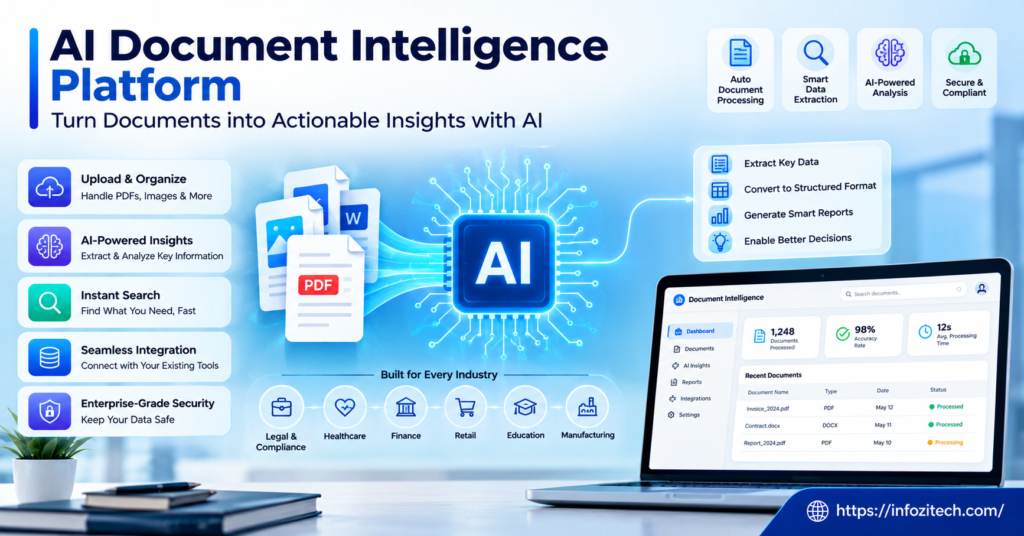
A real document intelligence platform reads documents the way a person would, more or less — pulling out meaning, not just matching keywords. It can look at an invoice and know which number is the total versus the tax versus the line item, without someone manually telling it where to look on that specific template. It can scan a contract and flag that the termination clause is missing, or that the payment terms don’t match what’s standard for that vendor. That’s a different thing entirely from a keyword search that just returns every file with the word “termination” somewhere inside it.
Under the hood, these platforms usually combine a few different technologies. Optical character recognition to actually read scanned documents and images. Natural language processing to understand what the text means, not just what it says. And increasingly, large language models that can summarize, extract, and answer questions about a document the way you’d ask a colleague who’d actually read the whole thing. Put together, it’s less “search tool” and more like having an assistant who’s read every document the company has ever produced and actually remembers what’s in them.
Why Businesses Are Adopting Document Intelligence Now
The Volume Problem
Companies generate an absurd number of documents. Contracts, invoices, HR files, compliance reports, emails with attachments nobody ever opens again. It used to be manageable when a filing cabinet could hold it. Now it’s terabytes spread across drives, email archives, and half a dozen SaaS tools that don’t talk to each other.
The Accuracy Problem
Manual document review is slow, and it’s also just not that accurate, no matter how careful the person doing it is. People get tired.
The Speed Problem
A loan application that used to take three days to process because someone had to manually check every document in the file can, with the right platform, take a few hours. Insurance claims. Vendor onboarding. Employee background checks. Anything that involves a stack of paperwork moving through review can genuinely move faster, and faster processing isn’t just a nice-to-have — it’s the difference between a customer who’s happy and one who’s shopping around for a competitor while they wait.
The Compliance Problem
Regulated industries — finance, healthcare, insurance — have to document everything, and prove they documented it correctly if anyone ever asks. An intelligence platform can flag missing required fields, inconsistent data across related documents, red flags in a way that’s traceable and auditable later.
Core Capabilities to Look For
Intelligent Data Extraction
The platform should pull structured data — names, dates, amounts, terms — out of unstructured documents without needing a rigid template for every single document type it’s ever going to encounter. This matters a lot because real-world documents are messy.
Document Classification
Automatically sorting incoming documents into the right category — is this an invoice, a contract, a resume, a compliance form — without a human eyeballing every single one first and routing it manually. Sounds small.
Natural Language Search and Q&A
Being able to ask “what’s our standard payment term with this vendor” and get an actual answer, pulled from the relevant document, instead of a list of files someone still has to open and read through themselves.
Workflow Automation
Once a document’s understood, the platform should be able to trigger what happens next. Route a contract for legal review if it’s missing a standard clause. Flag an invoice for manual approval if the amount’s over a certain threshold. This is where document intelligence stops being a passive tool and starts actually saving time instead of just organizing information more neatly.
Integration With Existing Systems
A platform that doesn’t connect to the CRM, the ERP, or the existing document storage a company already uses creates yet another silo instead of solving the silo problem it was bought to fix
Choosing the Right Platform
Match the Platform to Document Types
Some platforms are built specifically for financial documents. Others focus on legal contracts, or healthcare records, or general business paperwork without much specialization in any one direction. A platform optimized for invoices might handle contracts poorly, and vice versa — worth testing on the company’s own actual documents before committing to anything long-term, not just relying on a vendor demo built around their cleanest sample files.
Consider Accuracy Requirements
Not every use case needs the same level of precision. Sorting internal memos into folders can tolerate the occasional mistake without much consequence
Factor in the Learning Curve
Some platforms need significant training on a company’s specific documents before accuracy gets good enough to trust. Others work reasonably well out of the box with minimal setup.
Implementation Challenges to Expect
Data Quality Issues
Garbage in, garbage out still applies, AI or not. Some upfront cleanup work, unglamorous as it sounds, usually pays off more than people expect it to.
Change Management
Employees who’ve done document review manually for years, sometimes decades, may resist a tool that changes their entire day-to-day workflow. This isn’t really about the technology itself most of the time — it’s about clearly explaining what the platform actually does, and just as importantly what it doesn’t do, so people don’t walk in fearing it’s about to replace them when it’s actually there to take the tedious part off their plate.
Realistic Expectations
AI document intelligence isn’t perfect, and it’s not going to be perfect anytime soon either. It’ll make mistakes, especially early on before it’s had time to learn the specific quirks of a company’s documents.
Conclusion
An AI document intelligence platform isn’t just a fancier filing cabinet with a search bar bolted onto the front. Done right, it changes how a company actually interacts with its own information — turning documents from static files that sit there gathering digital dust into a resource people can actually search, question, and act on quickly. The businesses getting real value out of these platforms aren’t necessarily the ones with the most expensive tool.
The woman I mentioned at the start, hunting through that shared drive for a whole day? With the right platform in place, that search takes about thirty seconds. Multiply that kind of time savings across a whole company, a whole year, and it stops looking like a nice-to-have upgrade and starts looking like one of the more obvious investments a business can make.








1 thought on “AI Document Intelligence Platform: What It Is and Why Businesses Actually Need One”