
Future Workplace Technology Stack: Building the Digital Foundation for Tomorrow’s Office
I was on a call last spring with an ops manager at a mid-size logistics company, and she said something that stuck with me. “We didn’t choose half of this stack. It just happened to us.” That’s basically the story of most workplace technology right now. Nobody sat down in 2020 and designed anything elegant. People grabbed whatever kept the lights on — Zoom here, a spreadsheet there, some Slack channel that quietly became where real decisions got made — and a few years later that duct-taped mess is what leadership calls “our tech stack.”
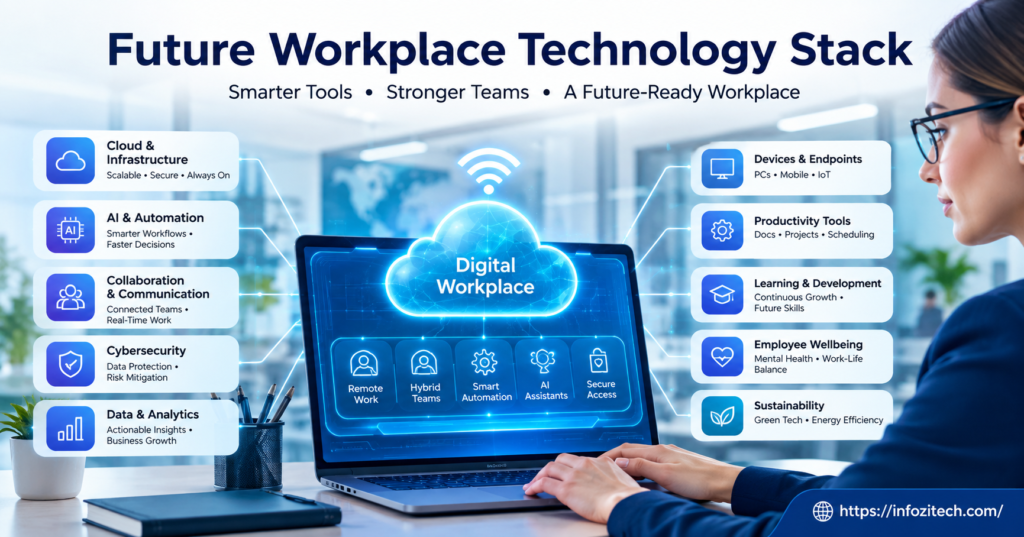
So no, the office as we knew it isn’t coming back, and honestly most people don’t want it to. What’s changed underneath is less obvious, though. Companies used to get by on a handful of licenses and a shared drive. Now it’s layers — communication tools stacked on infrastructure stacked on security stacked on some automation someone in finance set up without telling IT. It has to hold everything up at once, and a lot of it wasn’t built for that.
This isn’t really about adding more apps, even though from the outside that’s what it looks like. It’s whether the tools actually match how work happens now. Get it right, teams move faster, adapt without a crisis every time something shifts. Get it wrong — and plenty of companies have — and you’re left with tools that don’t talk to each other, employees quietly fed up, IT stuck firefighting instead of building.
What follows is my attempt to lay out what this stack looks like in practice, not the vendor-brochure version, plus some thoughts on building one without blowing up everything that already works.
Why the Workplace Tech Stack Is Changing
A few things are driving this, and they’re not happening one at a time — they’re stacked on each other, which is part of why it all feels so chaotic.
Remote and hybrid work, obviously. But people undersell how deep that change actually goes. It’s not just where people sit — it’s how decisions get made. A hallway conversation used to settle something in thirty seconds. Now that same thing is a Slack thread with four thumbs-up reactions and one person who never saw the message. Managers track progress differently. Status meetings turned into dashboards nobody fully trusts. The information still moves, just through different pipes, and some of those pipes leak.
Then there’s AI, which stopped being a buzzword a while back and just sort of embedded itself everywhere. Your email suggests a reply before you’ve thought of one. Scheduling software guesses the best meeting time, sometimes right. Support tickets get drafted responses before a human opens them. Nobody announced any of this — it just showed up inside the software people already had open, which is honestly the more interesting story than any big AI product launch.
And employees expect more, full stop. Grow up with instant search and one-tap checkout, and you don’t have much patience left for a company intranet that takes four clicks and a prayer to find a PDF from 2019. When internal tools feel slower than what’s on your phone, people notice, and it wears on them faster than most leadership teams realize.
Put those together, and the tech stack stops being an IT line item. It becomes strategy, whether companies planned for that or not.
Core Layers of the Future Workplace Technology Stack
Calling this a “stack” makes it sound tidier than it is. Really, it’s layers added at different times for different reasons, and the good ones happen to work together.
Communication and Collaboration Tools
This is the layer everyone lives in all day. Chat, video calls, shared docs, project boards. The tools themselves aren’t the hard part — everyone’s already got Slack or Teams or something similar. The hard part is whether a comment buried in a chat thread from three weeks ago can be traced back to the document it was actually about. Can anyone find that one recorded call from February? Usually not. That’s the real failure — not a lack of tools, but a lack of connection between them.
Companies that get this right stop treating each app like its own island. Everything ties back to one source of truth, so nobody’s asking “wait, is this the final version?” for the hundredth time this quarter.
Cloud Infrastructure and Hybrid Systems
None of the above works without something underneath holding it up. Cloud computing is what lets a team spread across three time zones work without someone scrambling to buy another server rack. But most companies aren’t fully cloud-native — not even close, in a lot of cases. There’s usually some legacy system still running on-prem because ripping it out is too risky, or a regulation says the data has to stay put.
That’s not really a failure. It’s just reality for most mid-size and large companies. What actually matters is whether the old system and the new one can talk to each other — because if they can’t, somebody’s manually copying data between them at 4 pm on a Friday, and that person is having a worse day than they deserve.
AI and Automation Layer
This is where the stack starts doing a bit of the thinking, not just storing stuff. Automation handles the boring, repetitive parts — routing tickets, generating routine reports, flagging odd spending, nudging someone about a contract deadline they forgot. AI sits on top, spotting patterns and making suggestions from data the company already has sitting around, mostly untouched.
The better setups don’t try to replace human judgment. They just clear the small, dumb decisions off the table so people have room for the ones that actually need a brain.
Cybersecurity and Identity Management
More tools, more logins, more data flying around — more chances for something to go sideways. This layer covers who gets access to what, identity verification, encryption, and monitoring.
Zero-trust is basically the standard now — nobody gets automatic trust just for being on the company network. Every request gets checked, every time. Sounds paranoid until you remember half the workforce is on coffee-shop wifi with a network name like “FBI Surveillance Van.”
Data and Analytics Tools
Every layer above throws off data, and this is where it turns into something a person can actually use. Dashboards, BI tools, reporting. Without this piece, a company can be sitting on mountains of data and still be flying blind — arguably worse than having no data at all, because it creates false confidence that somebody, somewhere, knows what’s going on.
Emerging Technologies Shaping the Stack
A few things just outside the “core” are pushing their way in, and it’s worth knowing where they actually stand versus where the hype puts them.
Artificial Intelligence Agents
There’s a real gap between an automation script that follows the same three rules forever and an agent that can string a few steps together on its own. A scheduling conflict pops up — the agent doesn’t just flag it; it reschedules the meeting, pings the attendees, updates the calendar, and you find out after it already happened. That’s the pitch anyway. Most companies are still poking at this cautiously, which they should be, because unsupervised decisions go fine ninety-nine times and then very much don’t on the hundredth. Still, the direction’s clear. Software used to help you do the task. Now some of it just does the task, and you check its work after.
Extended Reality (AR/VR)
Didn’t take off the way people predicted a few years back — remember when every conference talk had a metaverse slide? — but it found real footing in narrower lanes. Training simulations for hands-on jobs. Architecture firms doing virtual walkthroughs instead of flying a client out. Design teams collaborating in shared 3D space instead of squinting at a screen share. Not replacing the video call anytime soon, but for the industries it fits, it’s genuinely useful rather than a gimmick.
No-Code/Low-Code Platforms
Not everything needs an engineer, and that’s the whole point. No-code and low-code tools let someone without a programming background build a small app or automate a workflow themselves. A marketing coordinator who needs a simple approval flow doesn’t have to file a ticket and wait three weeks for a dev to squeeze it in. Takes real pressure off overloaded IT teams and puts the fix in the hands of whoever actually understands the problem.
Building a Future-Ready Tech Stack: Practical Steps
None of this comes from buying whatever’s trending on a vendor’s homepage. It’s slower, less glamorous work.
Assess Current Tools
Start by mapping what’s actually in use — not what’s on the invoice, but what people actually open every day. Plenty of companies are quietly paying for licenses half the team forgot existed. An honest audit turns up overlap, gaps, and dead weight draining budget for no return.
Prioritize Integration
A stack full of impressive tools that won’t talk to each other is still, functionally, broken. Integration should sit near the top when evaluating new software, not get discovered as a problem three weeks into rollout. APIs, single sign-on, shared data formats — none of it sounds exciting, but it’s the difference between a stack that works and one that just exists.
Train Employees
Great tools sit unused, or get used wrong, if nobody actually learns them. Training can’t be a one-and-done onboarding session. Tools update constantly, features get renamed and moved, and without ongoing training people fall back to whatever workaround they figured out two years ago — the whole point of upgrading quietly evaporates.
Challenges to Watch
None of this comes free, worth being straight about the friction instead of pretending it’s not there.
Tool fatigue is real — ask anyone juggling a dozen logins to get through a Tuesday. Cost creeps up too; subscriptions have a way of ballooning quietly until someone finally looks at the annual bill and winces. Data privacy is a genuine worry, more so now that AI tools are chewing through sensitive information in the background. And plain old resistance to change slows adoption even when the new tool is clearly better. People get comfortable. Comfort doesn’t lose to “better” nearly as often as it should.
None of that means companies should sit still. Just means doing it carefully instead of rushing because a competitor announced something shiny.
Conclusion
There’s no single product you buy that hands you a “future workplace technology stack.” It’s communication tools, infrastructure, automation, security, and data systems leaning on each other, ideally without anyone noticing the seams. The companies handling this well aren’t the ones with the biggest budget — they’re the ones treating it as ongoing, not a purchase made once and forgotten.
Getting there isn’t about chasing every headline. It’s slower — clear-eyed audits, integration that gets prioritized instead of assumed, training that doesn’t stop after week one. Less exciting than “AI transforms the workplace overnight,” sure. But it’s the version still standing in three years, which is more than most of the shiny stuff can say.





3 thoughts on “Future Workplace Technology Stack: Building the Digital Foundation for Tomorrow’s Office”