
Green Data Center Technologies: Building the Sustainable Backbone of the Digital World
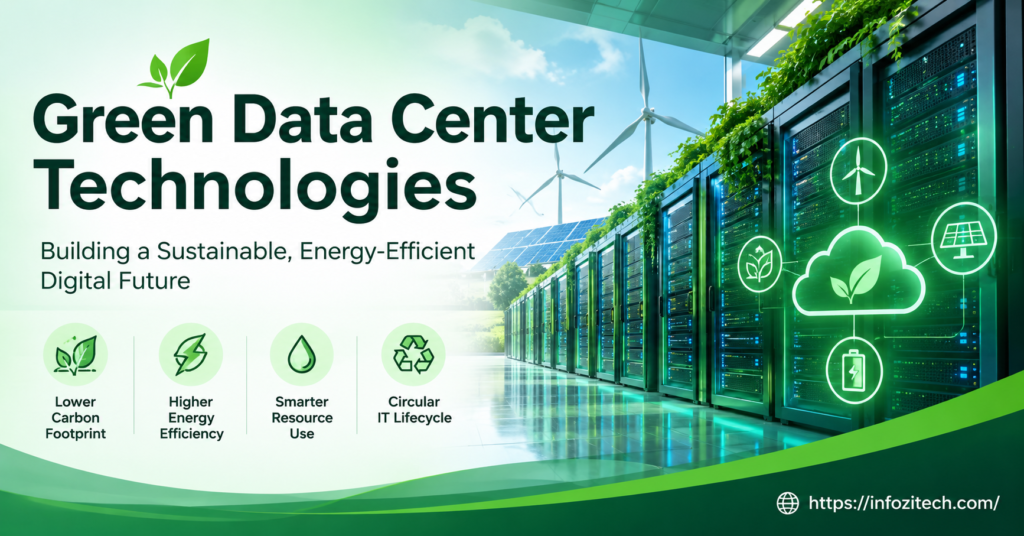
Think about what happens the next time you send a video call, or back up your phone, or ask an AI chatbot something dumb at 2 am. All of that traffic lands somewhere. A building, full of racks, humming away, usually somewhere you’ll never see. And that building has to be cooled, powered, and kept alive around the clock. As more of life moves online, those buildings are under real pressure — not just to keep running, but to stop wasting so much energy while they do it. That’s the whole idea behind green data center technologies. It’s not one gadget or one fix. It’s cooling, power sourcing, software, even the concrete the building is made of, all pulling in the same direction.
Here’s the thing though — this stopped being a “nice to have” a while back. Data centers already eat up a serious chunk of global electricity, and now AI workloads are piling on even more demand, fast- faster than most grids were built to handle. Operators aren’t rethinking their facilities because it looks good in a sustainability report. They’re doing it because the old way doesn’t scale anymore. Below is a look at what’s actually changing, technology by technology.
What Is a Green Data Center?
Put simply: a facility that tries to do the same job — keep servers running, keep uptime high — while using less energy, less water, and putting out less carbon to get there. It’s not a single upgrade you bolt on. It touches power delivery, cooling, which hardware you buy, where you even build the thing, and how it’s run day to day.
And no, it’s not really about optics, or shouldn’t be. Energy is one of the highest recurring costs in this business. Cut the waste, and you cut the bill. Sustainability and the bottom line stopped being separate conversations a while ago; now they’re basically the same conversation.
Why This Matters More Right Now Than It Did Two Years Ago
Generative AI changed the math. Training and running big models means dense racks of high-power chips, packed tight, generating heat levels that older air-cooled facilities were never designed for. Meanwhile, regulators in the EU, the US, and parts of Asia — they’re all tightening reporting rules around energy, water, emissions. Ignore that shift and you’re looking at higher costs down the line, penalties, and a reputation hit nobody wants.
Core Metrics Behind Green Data Center Performance
Before getting into the actual technology, it’s worth knowing how “green” even gets measured here. Otherwise the rest of this is just marketing language.
Power Usage Effectiveness (PUE)
This one compares total facility energy against the energy that actually goes to IT equipment. A perfect 1.0 would mean nothing gets lost to cooling or power conversion or lighting — which basically never happens in practice. Older buildings often run above 2.0. The newer hyperscale campuses? Closer to 1.1, sometimes 1.2 or 1.3. That gap is enormous when you scale it across an entire industry.
Carbon Usage Effectiveness (CUE) and Water Usage Effectiveness (WUE)
CUE tracks carbon emitted per unit of IT energy used. WUE does the same thing but for water used in cooling. Together with PUE you get a much fuller picture — and water especially matters more than people assume, particularly in places already dealing with drought.
Advanced Cooling Technologies
Cooling is usually the second-biggest energy hog after the servers themselves. Which also makes it the place where innovation is happening fastest.
Liquid Cooling Systems
A few years ago this was still considered kind of niche, almost experimental. Not anymore. AI hardware runs so hot that air cooling just can’t keep up in a lot of cases. Two approaches lead here:
Direct-to-chip cooling routes coolant through cold plates mounted right on the processors — pulls heat away way more efficiently than blowing air over it ever could. Then there’s immersion cooling, where you literally submerge entire servers in a non-conductive fluid. No fans needed. Lets you pack racks much denser too.
Either way, both cut cooling energy substantially compared to standard air systems.
Free Cooling and Outside Air Economization
In cooler regions, facilities lean on outside air (or water) to do the cooling work naturally, for big chunks of the year. Mechanical cooling barely has to kick in. It’s honestly one of the cheapest, simplest efficiency wins available — and it’s a big reason new data center campuses keep popping up in cooler, temperate climates rather than, say, the desert.
Evaporative and Adiabatic Cooling
These use water evaporation to bring air temperature down before it hits the servers. Energy-wise, great. Water-wise, not so much — that’s the tradeoff. So in places already short on water, operators are increasingly weighing that efficiency gain against the local cost, and a lot of them are shifting toward closed-loop setups instead, even if it means giving up some of the energy savings.
Waste Heat Recovery
Instead of just dumping excess heat into the atmosphere, more facilities are capturing it and piping it somewhere useful — district heating systems, greenhouses, nearby factories. Parts of Europe now actually require larger facilities to recover and reuse a minimum share of that heat. What used to be pure waste is turning into a resource for the surrounding community.
Renewable and Alternative Energy Sourcing
Solar, Wind, and Power Purchase Agreements
A lot of the bigger operators lock in electricity through long-term power purchase agreements with solar and wind farms. It secures supply and helps fund new clean capacity at the same time. Across the industry, the renewable share of data center power keeps climbing year after year — not dramatically, but steadily.
Nuclear and Geothermal Power
Solar and wind are great until the sun sets or the wind dies down. So operators are increasingly pairing them with steadier baseload sources — nuclear (including a fresh wave of interest in small modular reactors) and geothermal, both of which can deliver constant power without weather playing a role.
On-Site Battery Storage
Batteries are becoming almost standard now. They smooth out the ups and downs from renewable sources, they back things up during outages, and they let a facility pull grid power during cheaper, cleaner off-peak windows instead of peak demand hours.
Fuel Cells
Hydrogen and natural gas fuel cells are another option for backup power, offering a cleaner alternative to the diesel generators that have been the default for decades. In some setups they’re even handling primary power duties now, not just backup.
Intelligent Infrastructure and AI-Driven Optimization
AI-Powered Data Center Infrastructure Management (DCIM)
Modern DCIM software constantly watches temperature, humidity, airflow, power draw — all of it — and makes tiny adjustments in real time that no human team could realistically keep up with manually. It’s kind of the invisible workhorse of green data center technology. Nobody sees it happening, but it’s doing a lot of the heavy lifting.
Predictive Maintenance
Sensors paired with machine learning models can catch a failing part before it actually fails. That matters more than it sounds — emergency repairs waste energy, premature replacements waste resources, and a malfunctioning component quietly wrecking your cooling efficiency for weeks before anyone notices is a real, common problem.
Dynamic Workload and Server Optimization
Software now shifts computing jobs around — to different servers, different racks, sometimes entirely different facilities — depending on where energy happens to be cheapest or cleanest at that exact moment. People call this “carbon-aware computing.” The idea is simple: lean on renewables when they’re abundant, pull back when the grid is dirtier.
Sustainable Hardware and Facility Design
Energy-Efficient Servers and Chips
Each new generation of processors squeezes out more performance per watt than the last. Picking efficient silicon, paired with high-efficiency power supplies, is one of the most direct ways to lower baseline energy draw — before cooling even becomes part of the equation.
Modular and Prefabricated Data Centers
Building facilities in standardized modules off-site, then assembling them on location, cuts construction waste and lets capacity scale to match actual demand instead of guessing years ahead and over-building. Right-sizing, basically. Avoids the waste of running a half-empty facility at full power.
Green Building Materials and Design
Reflective roofing that bounces back heat instead of absorbing it, recycled materials in construction, smarter use of natural light — the physical shell of a data center matters too, not just what’s humming away inside it.
Certifications and Regulatory Standards Shaping the Industry
Governments — and industry groups too — are getting more specific about what actually counts as “green” these days, instead of leaving it to marketing departments to decide. The EU’s Energy Efficiency Directive now pushes larger facilities to report energy use publicly, recover waste heat, and work toward a shared efficiency rating scheme. Voluntary programs like the Climate Neutral Data Centre Pact nudge operators toward renewable power and tougher efficiency goals. In the US, state-level rules are starting to force bigger companies to disclose emissions — putting real pressure on operators to actually do the work rather than just buy offsets and call it a day.
Why does any of this matter? Because it creates accountability. Certifications like LEED, ENERGY STAR, ISO 50001 — they give businesses a way to check claims instead of just trusting a press release. For companies picking a colocation provider or cloud partner, these certifications have become a kind of shortcut for due diligence, separating the operators doing real work from the ones just buying their way to a clean-looking number.
The Role of Transparency in Building Trust
Public energy reporting is quietly one of the bigger shifts happening right now. Once a facility has to disclose its actual PUE, its water numbers, its emissions — it gets a lot harder to hand-wave sustainability claims without backing them up. That visibility alone is pushing even the more reluctant operators to actually invest in real upgrades, because customers and regulators and competitors can all see the numbers now.
Real-World Momentum
Some of the bigger cloud providers have already shown what’s possible — facilities running on close to 100% renewable power, PUE numbers creeping toward that theoretical 1.0 floor, waste heat systems literally warming homes and greenhouses nearby. This isn’t pilot-project territory anymore. It’s becoming the expected baseline for new builds, especially with AI demand making inefficiency a much more expensive mistake than it used to be.
Challenges on the Road Ahead
None of this comes easy, to be fair. Liquid cooling means real retrofitting costs. Renewable supply still swings by region and season — it’s not available everywhere, on demand. Water use for cooling remains a genuinely touchy subject in drought-hit areas. And AI capacity is expanding so fast that some operators, at least for now, are leaning on carbon-heavy backup power just to keep pace with demand they didn’t fully see coming. Balancing that growth against real sustainability commitments is probably going to stay the industry’s biggest tension for a good while yet.
The Path Forward
Green data center technologies aren’t some niche advantage anymore, held by a few companies trying to look progressive. They’re becoming the baseline expectation. Rising energy costs, tighter regulation, and the sheer scale of AI demand are all pushing the whole industry toward liquid cooling, cleaner power, waste heat reuse, and AI-managed operations — pretty much all at once, not one at a time like it used to happen.
For any business picking where to host its infrastructure, and for the people actually building these facilities, the takeaway is the same either way: efficiency and sustainability aren’t separate from performance and cost anymore. They’re the same conversation now. A facility running on outdated cooling and inefficient hardware isn’t just behind on environmental goals — it’s behind, period.
The data centers that hold up over the next decade will be the ones that treated sustainability as core engineering from day one, not as a box to check for a report nobody reads. Digital demand isn’t slowing down. So these buildings — the ones quietly running the internet in the background — are getting rebuilt, piece by piece, into something smarter, cooler, and genuinely greener.





3 thoughts on “Green Data Center Technologies: Building the Sustainable Backbone of the Digital World”