
Software License Tracking for Startups: Why It Matters More Than You Think
A friend who runs a twelve-person startup told me something last year that stuck with me. She said the first time she actually sat down and listed every piece of software her company was paying for, she found a $400-a-month analytics tool nobody on the team could remember signing up for. Not a huge number in the scheme of a startup budget. But nobody could explain it. Nobody owned it. It had just been renewing itself, quietly, for over a year.
That’s the thing about software licenses. They don’t feel like a problem until you actually look.
Most founders don’t think about this stuff until something forces the issue. A renewal charge that hits right before payroll and knocks the wind out of you a little. An audit email from a vendor asking pointed questions about seat counts you can’t answer off the top of your head. Or just a slow, boring realization, usually during a budget review, that you’re paying for a dozen tools and nobody’s totally sure why.
Whatever the trigger ends up being, the lesson is basically always the same. Software license tracking isn’t optional busywork. It’s closer to financial hygiene — unglamorous, easy to skip, and expensive to ignore for too long.
This piece is about why that sprawl happens specifically at startups, what it actually costs, and how to build a system for tracking it that doesn’t need a full IT department behind it. Because most startups don’t have one. That’s kind of the point.
Why Startups Are Especially Prone to License Chaos
Bigger companies have procurement teams. Approval chains. Someone whose whole job is asset management. Startups have none of that, generally. What they have instead is speed, and speed is great until it isn’t.
Every Employee Becomes a Buyer
Picture a five-person team. Anyone with a company card can sign up for a new tool in about ninety seconds. The designer grabs a Figma plan because she needs it today, not next week. An engineer spins up a monitoring service on a Tuesday afternoon without asking anyone. Marketing tries three competing analytics platforms at once just to see which one feels right, and two of them quietly stick around long after the decision’s been made.
None of this is really wrong, to be clear — this is how small teams are supposed to move, fast and a little loose. But the tradeoff is that no single person ever has the full picture of what’s actually being paid for. Not even the founder, usually.
Tools Outlive Their Usefulness
Companies pivot. Projects get shelved halfway through. The one person who championed a particular tool leaves for another job, and the subscription just… keeps going. Free trials quietly convert into paid plans, and nobody notices because the charge is small enough to not trigger alarm bells on a statement. This is exactly how a company ends up paying, eighteen months later, for a project management tool three different teams have already abandoned.
Nobody Owns the Problem
At a certain point, license tracking falls into this weird gap — not quite engineering’s job, not quite finance’s, not really HR’s either. So it becomes everyone’s problem in theory, and nobody’s in practice, until the annual budget review forces someone to go digging and ask, out loud, what half these charges even are.
The Real Cost of Not Tracking Licenses
Easy to write this off as a minor annoyance. It compounds in ways that sneak up on you, though.
Wasted Spend Adds Up Fast
Unused seats. Duplicate tools doing basically the same job because two teams never compared notes. A subscription that renewed automatically six months after the project it was bought for wrapped up. None of these look big in isolation — twenty bucks here, sixty there. Add it up over a year, and you’re often looking at a meaningful slice of monthly burn. Money that could’ve been another month of runway. Or, frankly, could’ve gone toward the next hire instead of sitting in a tool nobody logs into anymore.
Compliance and Audit Risk
Plenty of software vendors reserve the right to audit usage — seat counts, tier limits, license terms, all of it. If a startup has no clean record of who has access to what, or which plan they’re technically supposed to be on, that’s a real exposure. And it’s not just an awkward email exchange when it goes wrong. It can mean surprise fees, or a contract dispute, landing at the worst possible moment — usually right when you’re trying to close a round or hit a milestone.
Security Gaps From Orphaned Accounts
Here’s one people underestimate. Someone leaves the company, and if access isn’t tracked centrally, their login to half a dozen internal tools just… sits there. Active. Unwatched. That’s not only wasted money, but it’s a lingering security hole. Former employees, old contractors, vendor relationships that ended two years ago — all of them can retain access far longer than anyone intended, simply because nobody was tracking it in one place.
Slower, Messier Fundraising and Diligence
Eventually, an investor doing diligence, or an acquirer down the line, is going to ask what software the company runs on and what it’s costing. A founder who can pull that up in five minutes with a clean spreadsheet looks like they run a tight ship. A founder who has to go spelunking through eighteen months of credit card statements to reconstruct the answer looks like something else entirely, even if the underlying business is solid.
What Good License Tracking Actually Looks Like
None of this needs enterprise software or a hire dedicated purely to license management. What it needs is a system — applied consistently, not just set up once and forgotten — that can grow alongside the company.
Start With a Full Inventory
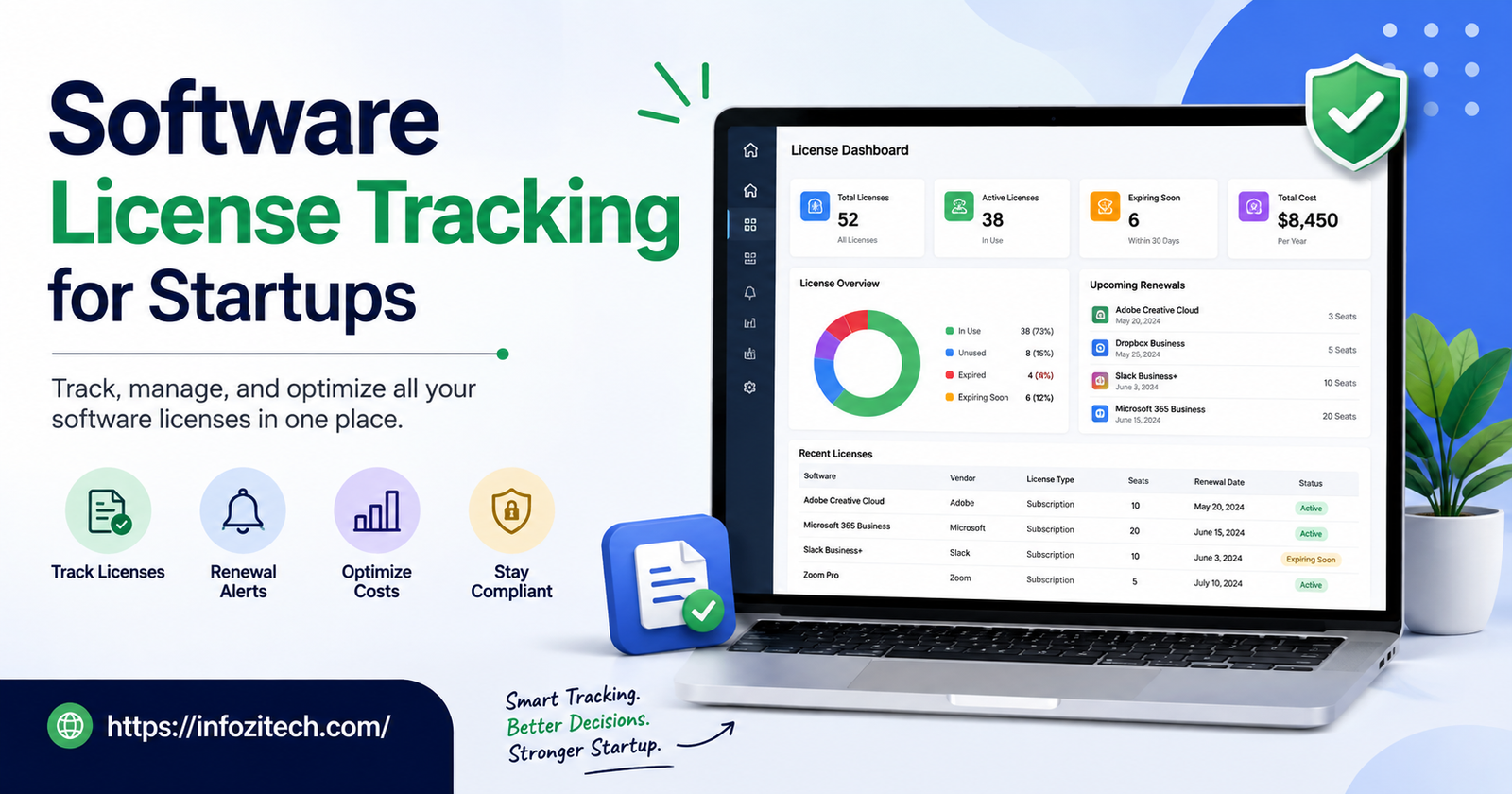
Before you build any kind of process, you have to actually know what you’re dealing with. Pull bank and credit card statements back twelve months. List every recurring software charge you find, even the small ones, especially the small ones, honestly, because those are the ones that hide. Cross-reference that list against whatever tools people on the team mention using day to day. You’ll almost always find a few gaps — tools bundled into an annual charge, or paid through a card that doesn’t show up in the usual place.
For each tool, jot down the basics:
- Vendor and product name
- Plan tier and number of seats
- Monthly or annual cost
- Renewal date
- Who owns the relationship internally
- Which team or function actually uses it
Assign an Owner for Every Tool
Every piece of software needs one person attached to it. Not necessarily the heaviest user — the person accountable for knowing whether it’s still needed, whether the seat count still makes sense, whether the renewal is worth it. Skip this step and tools drift into a kind of “somebody else is probably watching this” limbo. That’s exactly how waste creeps in, quietly, over time.
Track Renewal Dates Like You Track Payroll
Annual contracts are where the ugly surprises hide, because one decision made a year ago just locks in and renews itself without anyone re-checking. Set a reminder at least thirty days out from any renewal. Give yourself time to actually ask whether the tool earned its keep this year, instead of letting the charge sail through on autopilot.
Tie Access to Onboarding and Offboarding
These two things — license tracking and the employee lifecycle — really shouldn’t live as separate processes. When someone joins, their access should be granted on purpose, tied to their role, written down somewhere. When someone leaves, killing their accounts needs to be a required offboarding step. Not something that happens “eventually,” whenever someone happens to notice an old login still working.
Choosing a Tracking Method That Fits Your Stage
How you track this depends a lot on how many tools and people you’re actually managing. Don’t overbuild this early. Seriously.
Spreadsheets Work Fine at the Early Stage
Under fifteen or twenty people, a well-kept spreadsheet does the job. The operative word being “well-kept” — it needs an owner and a standing monthly reminder to actually open it and update it. A spreadsheet that nobody touches after month one is arguably worse than nothing, because it gives you false confidence that things are under control when they aren’t.
SaaS Management Platforms for Growing Teams
Once you’re into dozens of tools and a growing headcount, dedicated SaaS management platforms start earning their keep. They typically hook into your finance system, your SSO provider, or your expense tool to auto-detect subscriptions, flag seats that have gone quiet, and surface renewals before they hit. It turns license tracking from a manual chore into something closer to passive monitoring.
IT Asset Management Systems for Later Stages
As a company matures into something bigger, with real compliance requirements attached, broader IT asset management systems start making sense. These go past just software subscriptions — hardware, security posture, formal audit trails, the works. Overkill for a ten-person team. Worth it once there’s enough scale and regulatory weight to justify it.
Building Habits That Keep Tracking From Falling Apart
A system’s only as good as the discipline behind it, and that’s the part most companies skip. A handful of habits separate a tracking process that actually sticks from one that quietly dies the first time the team gets busy — which, let’s be honest, is most weeks.
Monthly Reviews, Not Annual Fire Drills
Checking the inventory once a year, right before budget season, guarantees you’re always reacting instead of planning ahead. A short check-in every month — fifteen, twenty minutes, nothing dramatic — catches problems while they’re cheap and easy to fix instead of after they’ve compounded.
Make It Someone’s Actual Job
Doesn’t need to be full time. Does need to be an explicit responsibility that sits with one person in finance or ops, someone who’ll actually notice if it slips. “Everyone’s job” tends to become, in practice, nobody’s job.
Ask Before Renewing, Not After
Build the habit of asking three quick things before any renewal goes through: Is this still getting used? Is the seat count actually accurate? Is there a cheaper option now that fits better than it did a year ago? Takes a few minutes. Can meaningfully change what the company pays year over year.
Keep the Inventory Somewhere Everyone Relevant Can See
A tracking sheet buried in one founder’s personal drive doesn’t help anyone else. Put it somewhere finance, department heads, and whoever handles IT can actually get to and update — so it reflects what’s really going on, not just what one person happens to remember.
Final Thoughts
Software license tracking isn’t exciting work, and it’s easy to see why it keeps getting pushed down the list at a startup where basically everything feels urgent. But the cost of ignoring it doesn’t go away. It just shows up later, usually at a worse moment, as wasted spend, a security gap, or an uncomfortable conversation during an audit or a diligence process.
The good news, if there is one, is that fixing it doesn’t take heavy tooling or a big team. It takes a clear inventory, a named owner for every tool, a habit of actually questioning renewals instead of letting them run on autopilot, and a system that only gets more complex once the company genuinely needs it to. Get those basics in early, and this becomes one less thing that can quietly go sideways as the business grows.





2 thoughts on “Software License Tracking for Startups: Why It Matters More Than You Think”