
Beginner Reaction Speed Drills at Home: How to Get Quicker Without Leaving the House
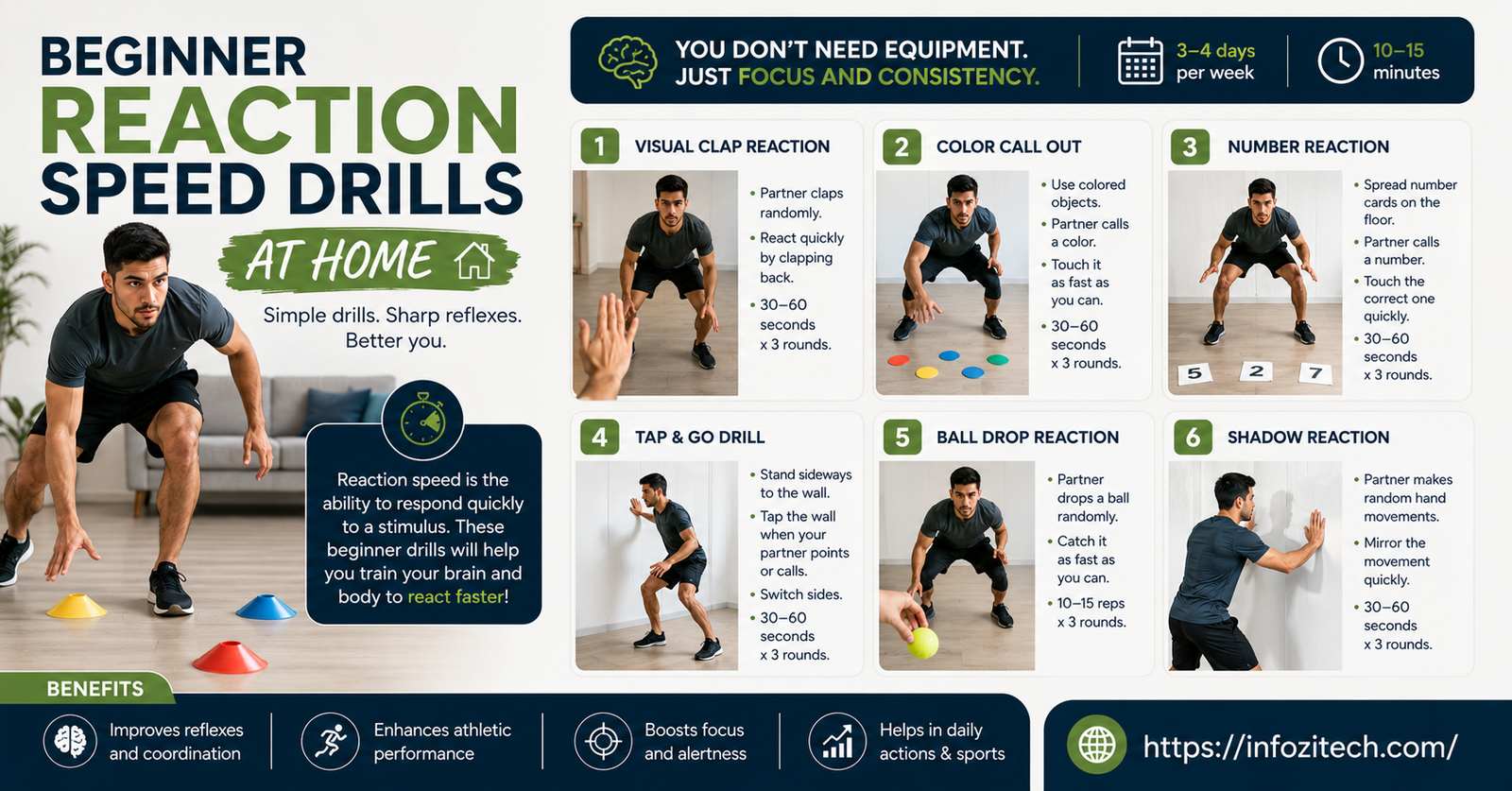
Somebody drops something in the kitchen, and you catch it before it hits the floor — or you don’t, and you just watch it fall like your hands forgot how to work. That gap, that split second between “thing is happening” and “I did something about it,” is reaction time. And here’s the good news nobody tells you: it’s trainable. Not in some mystical way either. With actual drills. At home. No gym membership, no fancy reaction-light gadget you saw on a fitness influencer’s page (though those exist and they’re fun, just not necessary).
Reaction speed isn’t the same thing as being fast in general. You can be a decent runner and still have slow reflexes, and vice versa — some of the quickest-reacting people you’ll ever meet couldn’t run a mile without stopping. It’s a different system. It’s about how fast your brain processes a stimulus and fires off the right response, and like most systems in the body, it responds to practice.
This is written for beginners. If you’re already doing agility ladder work three times a week and reading sports science journals for fun, this probably isn’t for you. But if you’re someone who wants quicker hands, better reflexes for a sport you play on weekends, or honestly just wants to stop dropping your phone every time it buzzes unexpectedly, keep reading.
What Reaction Time Actually Is (and Why It Matters More Than You’d Guess)
Reaction time gets split into a few categories by people who study this stuff for a living, but for our purposes there’s really just two that matter. Simple reaction time — one stimulus, one response, like catching a ball the second it’s thrown. And choice reaction time — where you’ve got multiple possible stimuli, and you have to pick the right response fast, like a goalkeeper deciding which direction to dive.
Most sports need both, honestly, but beginners should start with simple reaction drills. Build the base first. Choice reaction stuff gets layered in once your nervous system is used to firing quickly at all.
And it’s not just athletes who benefit, by the way. Reaction time matters for driving. It matters for catching yourself when you trip on the sidewalk, which, let’s be honest, happens to everyone eventually. It matters for typing, for gaming, for just about anything where your body needs to respond to information faster than you can consciously think about it.
Why Reaction Time Slows Down (and Why That’s Fixable)
Reaction time naturally declines a bit with age, sure, that’s real. But a huge chunk of what feels like “slow reflexes” in regular untrained people isn’t age — it’s just lack of practice. The nervous system pathways involved in quick reaction, the connection between your eyes seeing something and your muscles responding, get faster and more efficient with repeated use. Same as anything else you train.
Setting Up a Reaction Speed Space at Home (You Probably Already Have One)
You don’t need much. A clear patch of floor, maybe six feet by six feet if you’re doing footwork drills, though some of these you can do sitting at a table. A tennis ball or two. A partner if you can rope one in, though plenty of these work solo. That’s basically it.
Some people like to grab a few household items to add variety — a deck of cards, a stopwatch or phone timer, maybe a couple of different colored balls or objects if you want to add a choice-reaction element later on. None of it’s required to start.
Drills for Absolute Beginners
Start here if you’ve never done any reaction training before. Don’t skip ahead just because these look too easy — the point at the beginning isn’t intensity, it’s building the neural pathway. Speed comes with reps.
Ball Drop Catch
This is the classic for a reason. Have a partner hold a tennis ball at shoulder height, arm extended, and you stand facing them with your hand open and ready, maybe six inches below where the ball will be. They drop it without warning — no “ready, set, go,” that defeats the purpose — and you try to catch it before it passes your hand.
Miss a bunch at first. Everyone does. That’s not a sign you’re bad at this; it’s just what beginner reaction training looks like. After a couple weeks, most people notice a real difference.
Solo variation, if you don’t have a partner handy: hold the ball yourself at shoulder height with one hand, let it go, and try to catch it with the other hand before it drops too far. Weirdly, it still works even though you know exactly when it’s coming, because your brain is anticipating movement instead of just reaction, and there’s value in both.
Wall Toss Reaction
Stand a few feet from a wall, toss a tennis ball against it at a random angle so you don’t know exactly where it’ll bounce back, and try to catch it. This one builds reaction speed and hand-eye coordination together, which is honestly most of what you need for a lot of sports.
Mix up your distance from the wall as you get more comfortable. Closer means less time to react, which sounds harder, and it is, but that’s the point.
Clap Catch
Toss the ball straight up, clap once (or twice, once you’re better) before catching it. Sounds silly, feels a little silly doing it in your living room, but it forces your brain to process a secondary task while still tracking and reacting to the ball’s flight. Good building block for more complex drills later.
Intermediate-Leaning Beginner Drills
Once the basics feel easy — like, actually easy, not “I’m getting it eventually” easy — move into these. They add a decision-making element, which is where reaction training starts overlapping with real sport situations.
Card Flip Reaction
Grab a deck of cards. Have a partner flip cards over one at a time, and assign yourself a task based on color — say, clap when it’s red, don’t move when it’s black. Or get more specific: touch your left knee for hearts, right knee for diamonds, jump for clubs, stay still for spades. Whatever combination you want, really.
This is choice reaction training in its simplest form. Your brain has to identify the stimulus, decide on the correct response, and execute — all in a fraction of a second. It’s harder than it sounds and genuinely tiring after a few minutes, in a good way.
Solo Version With a Phone
No partner? Plenty of free reaction-time apps let you do a version of this on your phone, flashing colors or shapes and timing your response. Not quite the same as physical movement but still useful, especially on days you’re stuck indoors with nobody around to drill with.
Mirror Drill
Stand facing a partner, a few feet apart. One person moves — side to side, forward and back, small random hops — and the other tries to mirror the movement as quickly as possible, like you’re each other’s reflection. Switch roles after a minute or two.
This one’s deceptively exhausting and it trains reactive footwork specifically, which matters a lot for sports like tennis, basketball, soccer, anything with lateral movement and quick direction changes.
Falling Stick Catch
This one needs a partner and a yardstick, broomstick, or something similar. They hold it vertically, you position your hand near the bottom without touching it, and they drop it without warning. You try to catch it as fast as possible. Mark where you catch it — lower down the stick means faster reaction time — and track your progress over a few weeks. It’s a genuinely satisfying way to see measurable improvement, since the marks don’t lie.
How Often Should Beginners Actually Train This?
Three times a week is plenty when you’re starting out. Reaction training taxes the nervous system more than it taxes muscles, so there’s not much benefit in going daily, and honestly you risk burning out on it if you push too hard too fast — the drills stop feeling fun and start feeling like a chore, which defeats half the purpose.
Sessions don’t need to be long either. Fifteen, twenty minutes is enough for a beginner. Quality of attention matters way more than volume here — half-focused reaction drills where you’re checking your phone between reps aren’t doing much for you.
Tracking Progress Without Overthinking It
Keep it simple. Note how many catches out of ten you’re getting on the ball drop drill, or how far down the stick you’re catching it, and check back in every couple weeks. You don’t need a spreadsheet. You just need some rough sense that the numbers are trending the right direction, because they will, pretty reliably, if you’re putting in consistent short sessions.
Don’t get discouraged by a bad session either. Reaction time has natural day-to-day variability — tired, stressed, distracted, all of it shows up in the numbers a little. One off day doesn’t undo weeks of progress.
Putting It All Together
A realistic beginner week might look like this: one session focused purely on simple reaction drills, ball drop and wall toss, nice and basic. One session mixing in the card flip and mirror drills for a bit of choice-reaction work. And one session that’s a loose combination of whatever felt good, maybe with a friend if you can get one to join, because honestly these drills are more fun with another person there anyway, even if it’s not strictly necessary.
Reaction speed training is one of those areas where consistency beats intensity by a wide margin. Nobody gets dramatically faster reflexes from one brutal session. It’s the small, repeated, unglamorous reps — dropping a tennis ball for the two hundredth time, flipping cards in your living room on a random Tuesday — that actually rewire things. Give it a few weeks of showing up, even just fifteen minutes at a time, and you’ll likely notice it in ways beyond the drills themselves. Catching things you’d normally fumble. Reacting a beat quicker in whatever sport or activity brought you here in the first place. It adds up quietly, and then one day you notice it’s just there.







1 thought on “Beginner Reaction Speed Drills at Home: How to Get Quicker Without Leaving the House”