
Weekend Wellness Routine for Busy Professionals: How to Actually Recover Before Monday
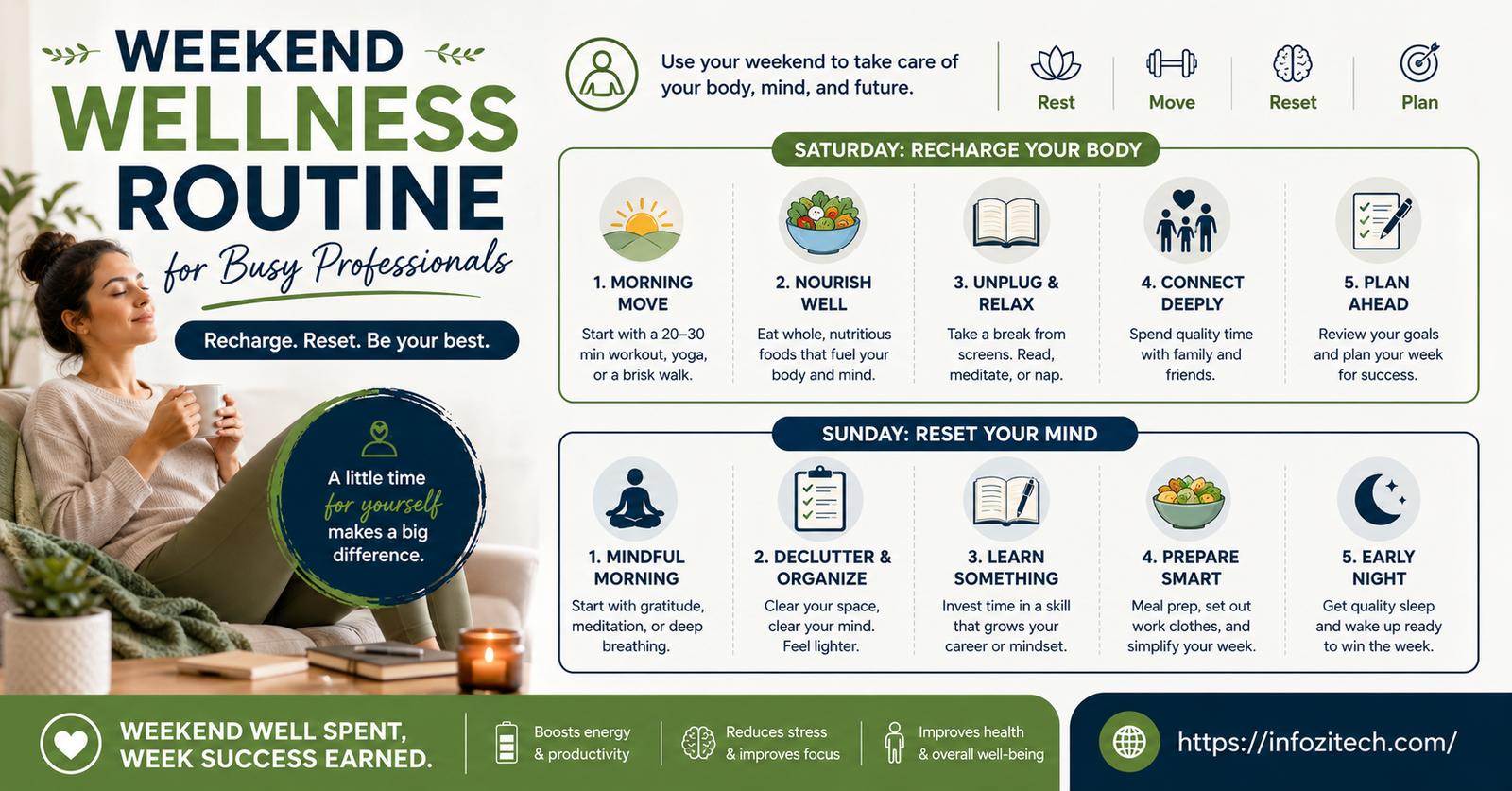
Friday night. You close the laptop, or you mean to, and somehow you’re still half-answering a Slack message at 9 p.m. because “it’ll just take a second.” Then the couch. Then it’s Sunday and you have no idea where the weekend went, except you know it wasn’t spent resting, not really, because you still feel like you got hit by a bus. Monday’s already looming and you haven’t even started.
Sound familiar? Most people don’t have a rest problem because they’re lazy. They have a rest problem because nobody actually teaches you how to do it. School doesn’t cover it. Nobody sits you down at your first job and says, hey, by the way, recovery is a skill and you’re going to need to practice it. So you wing it. You spend Saturday running the errands that piled up all week, and you call that a weekend.
It isn’t, though. Not really.
This isn’t going to be one of those pieces telling you to wake up at 5 a.m. and cold plunge before journaling for forty-five minutes. If that’s your thing, fine, more power to you. But most of us are exhausted, and stacking a new rigid routine on top of an already exhausting week just gives you one more thing to fail at by 10 a.m. Saturday. What follows is looser than that. More of a rhythm than a schedule. Something you can actually keep.
Why the Weekend Actually Matters (More Than You’d Think)
Here’s the thing about stress — it doesn’t just go away because the workday ends. It builds. Thursday afternoon, you can practically feel it stacking up, and if you never give your body a real chance to come down off that, it just keeps piling on top of itself, week after week, until you’re the person who snaps at a barista over a wrong coffee order and doesn’t totally understand why.
Recovery periods are what let your nervous system actually shift gears — out of that low-grade fight-or-flight hum and into something closer to rest, where your body can repair. Skip that part and you’re basically running a race and never stopping for water. You’ll finish. Eventually. Just not well.
The Trap of the “Productive” Weekend
And here’s where a lot of people go wrong, myself included for a long time: they turn Saturday into a second job. Meal prep, deep clean, “just a few emails,” maybe a side project you’ve been meaning to get to. All of it dressed up as self-improvement. None of it actually restful.
A real weekend wellness routine isn’t about cramming more in. It’s the opposite, honestly. Less, but on purpose.
What a Realistic Routine Actually Looks Like
Forget the version of this you’d see on someone’s perfectly lit Instagram story — green juice, 6 a.m. sunrise, all of it. That’s not a routine, that’s a highlight reel. What actually works is something built around your life. Your energy. Your kids, if you have them. Your actual bank account. Here’s a framework, loosely. Bend it however you need to.
Friday Night Sets the Tone (Whether You Plan For It or Not)
Most people blow right past this one. You finish work — or “finish,” since work has a way of following you home — and go straight into scrolling on the couch, and your brain never really registers that the week is over. There’s no signal. No boundary. It just… bleeds into the weekend.
So build one. Doesn’t need to be elaborate:
Change out of your work clothes, even if “work clothes” today meant sweatpants and a decent-looking top for Zoom. Do a five-minute tidy of the living room so tomorrow-you wakes up to something calm instead of chaos. Cook something with a little more effort than a weeknight meal, because you actually have the time now. Put the phone in another room for an hour. Just try it.
None of this is complicated. The point is just drawing a line — work mode, off. Weekend mode, on.
Saturday Morning Should Be Slow, Not Scheduled
This is where most wellness advice loses me, honestly. Wake up at dawn, immediately optimize everything — journal, workout, cold shower, all before 8 a.m. For some people that genuinely works and good for them. For the rest of us running on a sleep deficit that’s been building since March, it mostly breeds resentment.
Try slow instead of scheduled. Sleep until you actually wake up, within reason. Make coffee without rushing through it like it’s a pit stop. Sit somewhere with actual daylight for ten minutes before you touch your phone — this one sounds small and kind of woo, but it does something.
Movement That Isn’t a Chore
Move your body, sure, but it doesn’t need to be A Workout with capital letters. A walk. A bike ride if the weather’s decent. Stretching on the living room floor with a podcast going. The point isn’t calories. It’s circulation, and honestly it’s just getting your brain to reset a little.
Eating Like You Have Time, Because You Do
Breakfast, or brunch, whatever — sit down for it. Actually sit. This is not the moment for a granola bar eaten in the car. It doesn’t need to be some perfectly balanced plate either. Just eat slowly, at a table, without a screen propped against the ketchup bottle.
Saturday Afternoon: Handle Life, But Don’t Let It Take the Whole Day
Errands live here. Chores live here. Pretending your weekend can exist entirely outside of logistics isn’t realistic — groceries still need buying, the dry cleaning still needs picking up. Fine. But give it a window. Two hours, maybe three. Not the whole afternoon.
One trick that actually helps: batch it. Groceries, pharmacy, dry cleaner, one trip, not three separate outings spread across the day. Same with chores — pick a block, put music on, blitz through it. When the window closes, it closes. Whatever’s left waits until next week, or somebody else handles it.
Saturday Evening: Pick Connection or Pick Solitude, But Pick
Evenings are where a lot of us default to autopilot — hours of TV, or scrolling, that somehow leave you feeling flatter than when you started instead of refreshed. Try picking on purpose instead. Dinner with a friend. A call with your mom. Game night. Or, on the flip side, real solitude — a hobby you never get to during the week, a book, an ambitious recipe you’ve been avoiding, a puzzle spread across the coffee table for three days.
Both count as rest. What matters is that you actually chose it, instead of falling into it because you were too tired to decide anything else.
Sunday Is a Different Animal Entirely
There’s a specific kind of dread that shows up on Sunday. People call it the Sunday scaries, and it’s real, that low hum of anxiety about the week ahead creeping in around 4 p.m. A decent weekend routine doesn’t pretend that away. It plans around it.
Protect Sunday Morning
If Saturday handled the logistics, let Sunday morning stay untouched. This is your best window — a longer walk, time outside, a slow breakfast, whatever actually restores you. Resist the pull to fill it with leftover tasks from the week. Those can wait another few hours.
A Little Planning, Not a Lot
Sometime around midday, do a small amount of planning. Emphasis on small. This isn’t the moment to open the laptop and start clearing your inbox — that’s a trap and you know it. It’s more like orienting yourself. Glance at the calendar. Write down the two or three things that actually matter this week. Lay out clothes, maybe, or jot a grocery list.
It sounds minor but it does a lot of work. Knowing roughly what Monday looks like keeps your brain from spinning up worst-case scenarios just to fill the silence.
The Twenty-Minute Reset
Set a timer for twenty minutes. Tidy your workspace, prep one thing for a weekday meal, lay out what you need for the morning. When the timer goes off, stop — even if you’re not “done.” This isn’t about finishing. It’s about momentum, and about not letting Sunday planning swallow the whole evening the way it wants to.
Wind Down Like You Mean It
This is the part almost everyone skips, and it might be the most important one. Instead of letting Sunday night dissolve into anxious scrolling or a slow-building spiral about Monday, build an actual wind-down.
A proper dinner — something warm, something that isn’t eaten standing at the counter. Screens off half an hour or so before bed, longer if you can manage it. A minute spent thinking of one good thing from the weekend, even if the weekend was mostly ordinary. Clothes laid out, bag packed, lunch sorted, so Monday-you has one less decision to make at 7 a.m. And go to bed earlier than you would on a Tuesday — sleep debt doesn’t really get repaid the way people like to think it does, so don’t count on catching up later.
Making It Actually Stick
Routines fail when people try to overhaul everything in one weekend. If none of this currently applies to your life, don’t attempt the whole thing this Saturday. Pick one piece. The Friday transition, maybe. Or just the Sunday wind-down. Build from there, slowly, and let the rest come later or not at all.
It’s also worth staying flexible depending on what’s going on. A brutal work quarter is going to call for a different routine than a slower stretch, and that’s completely fine — this was never about hitting some perfect standard every single weekend. It’s about giving yourself permission to treat rest as necessary instead of optional, and stacking a few small, repeatable habits that make Monday feel like a fresh start instead of a wall you’re walking into face-first.
A weekend wellness routine for busy professionals doesn’t need six free hours or a schedule taped to the fridge. It needs a little intention — a handful of choices, made on purpose, that let your nervous system actually exhale before the week starts up again. Start small. Stay loose about it. And when a weekend doesn’t go to plan, which it won’t, some weekends, that’s not failure. That’s just being a person with an actual life. Which, if we’re being honest, is exactly who this is for.









3 thoughts on “Weekend Wellness Routine for Busy Professionals: How to Actually Recover Before Monday”