
Local Service Business Automation Ideas
A guy who runs a small HVAC company told me once, standing in his driveway with a coffee gone cold, that he spent more hours on his phone chasing no-shows than he did actually fixing furnaces. Some weeks. Not every week. But enough that it had started to feel normal to him, which is the part that got me.
It’s not really about the furnaces though. That’s the thing. It’s never the actual work that buries a local service business, whatever the trade is. It’s the calling. The texting. “Hey, are we still on for Tuesday?” An invoice that sat in somebody’s inbox for three weeks because nobody circled back on it, and by the time anyone remembered, the customer had half-forgotten they even owed anything.
Local service businesses — plumbers, electricians, cleaners, landscapers, pest control, doesn’t matter which one — run on this strange mix of skilled hands-on work and just relentless coordination underneath it. And nobody trains for the coordination part. You don’t take a class on dispatching in trade school. You figure it out badly, for years, with a paper calendar or a group text that got out of hand sometime around year two and never got fixed.
This is where automation actually earns its keep. Not the flashy AI stuff everyone’s shouting about right now. Just the boring plumbing underneath a business running smoother, so the owner isn’t personally the bottleneck for every single thing between a booking and a paid invoice.
Why Local Service Businesses Are Different From Other Small Businesses
A lot of the automation advice floating around online is written with someone selling digital products in mind, or running an online shop. Doesn’t map cleanly onto a business where a person has to physically drive to a house with a truck full of tools. Drive time exists. Weather cancels jobs. And a customer is standing in their kitchen who wants to know exactly when someone’s showing up. Not “sometime this afternoon,” which is what half these businesses still tell people.
The Coordination Problem Nobody Really Talks About
Here’s what eats the day. Not the job itself, usually. Confirming the job happened. Confirming someone’s actually home. Rescheduling because it rained, again. Following up because an invoice never got paid and now it’s been a month and the conversation feels awkward to even start. None of that takes skill exactly. It takes attention, and attention is the one resource an owner running solo never has enough of. You can be great at the trade and still bleed money because the business side is held together with sticky notes and good intentions.
Why Manual Systems Break Down Fast
Works fine at three jobs a week, a sticky note. Fifteen and it starts cracking. Thirty and you’re double-booking crews, or forgetting a callback that was supposed to happen last Tuesday, and it’s somehow Friday now. Growth exposes every crack in how a business runs, and here it shows up first in scheduling, almost always.
Scheduling and Dispatch Automation
Probably the single biggest win here. If a person does nothing else from this whole article. Do this one thing, seriously.
Online Booking That Doesn’t Need You
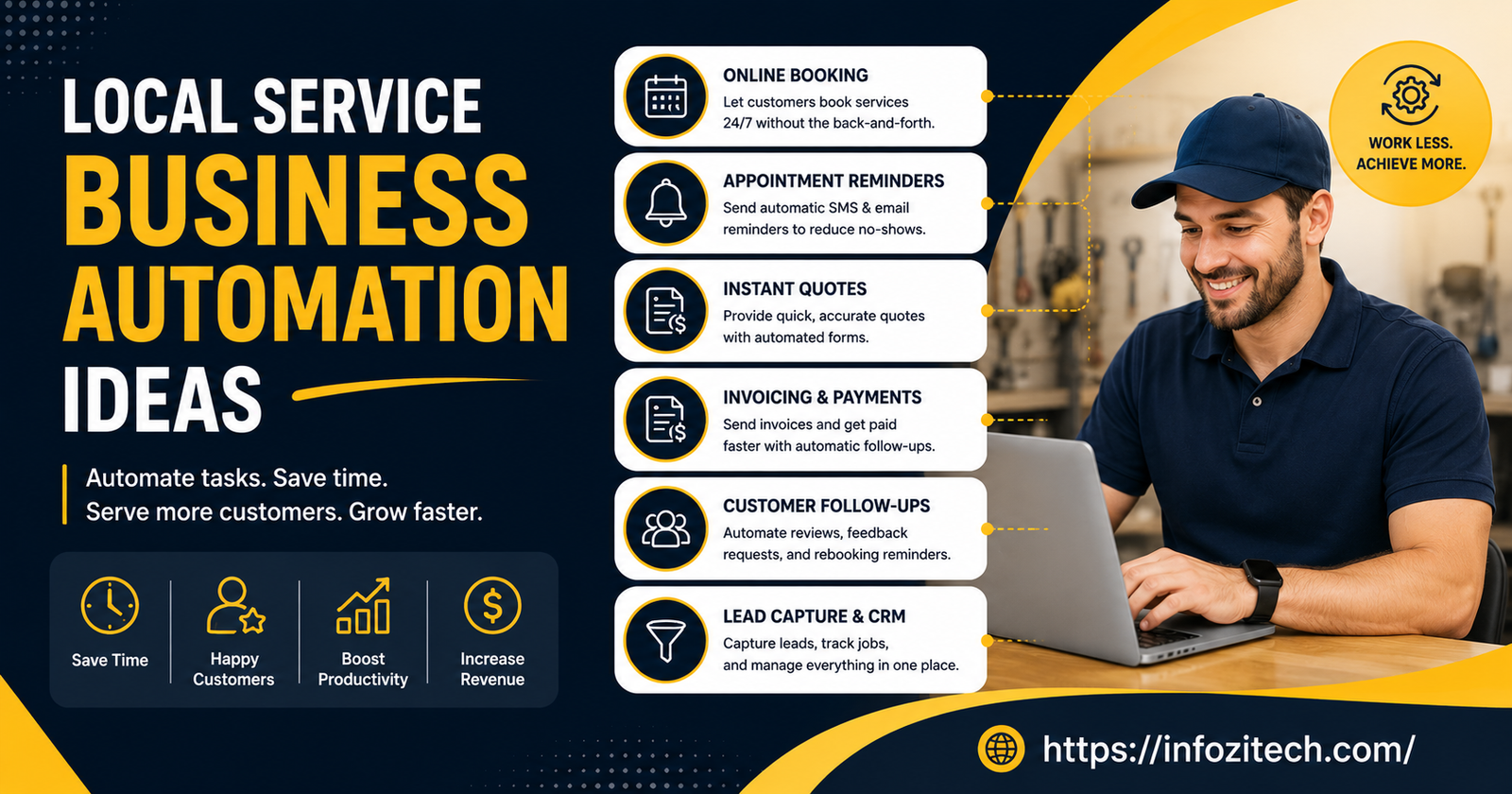
Customer wants to book a cleaning for Thursday. Right now that’s usually a phone call, or a text that sits unanswered for six hours because the owner had his hands inside a wall somewhere. Online booking that shows real availability lets the customer just pick a slot themselves. Sounds small. It’s not. Every unanswered booking request is basically a customer calling the next name on Google instead.
Automatic Route Optimization
Figuring out the smartest order to hit five houses by hand every morning wastes fifteen minutes a smart person could spend on literally anything else. Route software just does it instantly, and shaves real driving time off the day, which turns into another job squeezed in or the crew home at a reasonable hour.
Reminder Texts That Cut No-Shows
A plain automated text the day before — something like “see you tomorrow at 2, reply if you need to reschedule” — and no-shows drop. A lot. Not because people are flaky on purpose. Life’s busy, appointments slip people’s minds constantly, and a small nudge fixes most of that without anybody lifting a finger to send it manually.
Customer Communication Automation
Somewhere between “too robotic” and “drowning in unanswered messages” there’s a workable middle, and honestly most local service businesses haven’t found it yet.
Missed Call Text-Back
Call goes unanswered, and for a solo operator with grease on his hands, that happens constantly; an automatic text firing off within seconds saying something like “sorry we missed you, here’s how to book” saves jobs that would otherwise wander off to whoever answers next.
AI Chat for After-Hours Questions
Not every question at 9 pm needs a human awake to answer it. Do you service this zip code, what’s a rough price for a tune-up, are you licensed. A basic chatbot fed the business’s real info handles this fine, and captures the lead right then instead of losing it to whoever texts back first thing in the morning.
Review Requests Sent Automatically
Jobs are marked complete, and an automated text or email goes out asking for a review while the good feeling is still fresh. Gets way more responses than remembering to ask three days later. Let’s be honest, that rarely actually happens when it’s left up to memory.
Invoicing and Payment Automation
This is the part that quietly costs real money, not just time, and I think a lot of owners underestimate how much.
Invoices That Go Out the Same Day
Job finishes, invoice should follow within the hour. Not whenever the owner finally sits down some evening to catch up on paperwork he’s been avoiding for a week. Automated invoicing tied to job completion means the bill’s already sitting in the customer’s inbox before the truck’s even back at the shop.
Payment Reminders Without the Awkward Call
Chasing payment is nobody’s favorite conversation to have, ever. Automated reminders, polite, scheduled, impersonal in a good way, handle that follow-up so the owner never has to be the one calling to ask, again, where the check went.
Online Payment Options People Actually Use
People pay faster when they can just tap a link and put it on a card right there, instead of writing a check and finding a stamp, or waiting around for the owner to swing by later with a card reader. Faster payment is better cash flow. Simple as that.
Marketing Automation for Local Service Businesses
Marketing’s usually the first thing dropped the moment the phone’s ringing with actual paying work. Which is a mistake, because the phone won’t ring like that forever, and slow seasons always come around eventually.
Automated Follow-Up With Past Customers
Furnace tune-up from last October is due again this October, roughly. Gutter cleaning from spring needs repeating come fall. Automated seasonal reminders bring repeat business back without anyone remembering which customer needs what and by when. Realistically, nobody’s tracking that past maybe twenty customers.
Referral Requests Built Into the Workflow
Happy customers refer people, sure, but only if somebody actually asks. Asking is the easiest thing in the world to forget while you’re packing tools back into the van at the end of a long day. An automated message a few days after a good job, asking for a referral, maybe with a small incentive attached, catches word-of-mouth that would otherwise just quietly evaporate into nothing.
Google Business Profile Updates
Keeping hours, service areas, and photos current on a Google listing matters more for local search visibility than most owners realize. And it’s exactly the sort of task that gets ignored for months at a stretch without some kind of prompt or scheduled nudge forcing someone to actually go update it.
Simple Email Follow-Ups for New Leads
Somebody fills out a contact form, doesn’t book right away. Maybe they’re comparing a few companies. Maybe they just got busy and forgot the tab was even open. A short automated email sequence over the following week, no hard sell, just a reminder that the business exists and a quick way to book, catches a decent chunk of people who’d otherwise just disappear off the list entirely.
Building Your Own Automation Setup
Don’t need all of this on day one. Please don’t try setting it all up in one weekend; that’s a fast way to end up with half-configured tools nobody trusts.
Start With Whatever Hurts Most
Missed calls bleeding jobs? Fix that first. No-shows the real pain point? Start with reminder texts. Whatever’s costing the most, in time or actual dollars, solve that one thing before touching anything else at all.
Connect the Pieces So They Actually Talk to Each Other
A booking tool that doesn’t feed into the invoicing tool just creates two separate systems to babysit, which defeats half the point. Look for software that integrates, or bridge the gap with something like Zapier, so a booked job turns into an invoice turns into a review request, automatically.
Keep an Actual Person Somewhere in the Loop
Automation shouldn’t mean a customer can never reach a human when something’s genuinely gone wrong. Leave an easy way for people to get a real person on the line. This part matters. make sure someone’s actually checking those messages. Nothing tanks trust faster than an automated system with no escape hatch built in.
Go Back and Check It Every Few Months
Prices change. Service areas expand. A chatbot accurate in January might be quoting last year’s rates by August if nobody updates it. A quick check every month or so keeps things honest instead of quietly drifting wrong.
What a Normal Day Looks Like Once It’s Running
Picture a regular Tuesday, once this is actually up and running. Customer books online at 10 pm, nobody answers a phone for it. Crew’s route is already optimized before the first truck even pulls out of the lot. A missed call at noon gets a text-back within seconds instead of dying in voicemail like it used to. Job wraps up around 3, invoice is out by 3:15, and a review request fires two days later on its own. None of that required the owner to think about it, not once, the whole day.
That HVAC guy from the start of this — he eventually set up maybe three of these pieces. Nothing fancy, nothing expensive really. Told me later it was the difference between working every weekend and actually taking one off now and then. Not because the automation did his job for him. It didn’t fix a single furnace. It just stopped stealing all the hours that used to pile up around the job.
Final Thoughts
None of this requires turning into a tech person overnight. Most owners who’ve pulled this off started with one broken piece, usually scheduling or missed calls, fixed just that, and built outward slowly over months, not a weekend. It’s not about a fully automated business with nobody home. It’s about making sure the hours you’re not spending on the actual job aren’t quietly disappearing into busywork a piece of software could’ve handled instead.







4 thoughts on “Local Service Business Automation Ideas”